
An Empowering Guide for Muslim Women’s Halal Investment

An empowering guide for muslim women's halal investment.
An empowering guide for muslim women's halal investment
An empowering guide for muslim women’s halal investment

Muslim Women’s Halal Investments

An Empowering Guide for Muslim Women’s Halal Investment In today’s complex financial landscape, Muslim women stand at a powerful crossroads where faith meets financial independence. As an increasing number of educated Muslim women seek to grow their wealth while honouring Islamic principles, halal investing has emerged as both a spiritual practice and a financial strategy. This comprehensive guide moves beyond basic compliance to explore how you can build generational wealth while strengthening your connection to Islamic values, transforming your approach to money as an act of worship and empowerment.

“Do not give the foolish your property which God has assigned to you to manage.” – Quran 4:5

Reclaiming Our Financial Legacy

An Empowering Guide for Muslim Women’s Halal Investments

Taking back our financial legacy

In Islamic history, women’s economic role is praised. When she was married to Prophet Muhammad (PBUH), Khadijah bint Khuwaylid (RA) was a famous merchant who led trade trips between countries. Despite what many people think today, Islam protects women’s right to own, invest, and handle their own money. But modern barriers still exist:
The lack of trust: In the UK, only 10% of women have Stocks and Shares ISAs, while 17% of men do. This is often because women find financial terms confusing.

Inequalities in the system: The wage gap between men and women ($0.80 for every male dollar) makes it harder to invest.

An empowering guide for muslim women's halal investments
An empowering guide for muslim women’s halal investments

How much care costs: 37% of wealthy women give up job advancement to care for their families.

Somewhat surprisingly, women’s investments do better than men’s by 0.4% per year, which adds up to over $267,000. This is because they tend to do a lot of study, diversify wisely, and put long-term growth ahead of short-term gains.

How to Start Investing in Halal

Positive framework: Halal trading is more than just staying away from things that are haram; it’s a good way to build wealth that’s in line with Islamic principles:

The ban on riba (interest): “Allah will take away all good things about usury” (Quran 2:276). To do this, companies with debts greater than 30% of their market value must be screened, and arrangements such as Murabaha (cost-plus financing) or Ijara (leasing) must be used.

Haram Industries to Avoid: This list doesn’t include tobacco, weapons, gambling, booze, or pornography. Screening apps check thousands of funds to make sure they are legal.

Not Accepting Too Much Uncertainty (Gharar): Most experts agree that it doesn’t allow speculative instruments like day trading, derivatives, and cryptocurrency.

Profit and Loss Sharing: Investments must involve shared risk, like Sukuk (Islamic bonds backed by assets).

Purification of Wealth: If ≦5% of your income comes from sources that aren’t allowed, you have to give that money away as sadaqah.

Table: Core Screening Criteria for Halal Investments

ParameterThresholdPurpose
Debt Ratio<30% of market capAvoid interest-based leverage
Interest-Bearing Assets<30% of total assetsMinimize riba exposure
Haram Revenue<5% of total revenueExclude core non-compliant activities
Accounts Receivables<45% of market capPrevent excessive uncertainty

Ways to Make Halal Investments

1. Stocks and funds that follow Sharia law: 

Stocks through Halal ETFs or mutual funds that focus on healthcare, technology, and green energy.

Screening Tools: To make sure that individual stocks are compliant, use digital tools.

2. Real estate: something you can touch

Direct Ownership: Use Islamic financing (such as Murabaha or co-ownership methods) to make rental income.

Real estate investment trusts that follow Islamic law don’t take on interest-based debt or rent to haram renters.

Sukuk: A Moral Way to Get a Fixed Income

The world market for these asset-backed instruments is worth more than $700 billion. They let people own pieces of infrastructure or commercial projects.

4. Venture capital that cares

Halal venture capital platforms help ethical startups, combining diversification with investing with a purpose.

5. Metals of high value


Real gold and silver protect against inflation and are legal everywhere when fully held.

Your 5-Step Roadmap
An empowering guide for muslim women's halal investment
An empowering guide for muslim women’s halal investment

Step 1: Make your “why” clearer.

Set goals with different due dates:

Short-term (1–5 years): savings for Hajj and an emergency fund (in Islamic accounts)

Medium-term: Five to ten years from now: down payment on a house, business capital

Long-term (10 years or more): retirement, childhood schooling, and passing on wealth to future generations.

Step 2: Build Knowledge Confidently

Use screening tools and podcasts like Muslim Women and Finance.
Join groups for women who are interested in investing to get help.

Step 3: Start Small, Start Halal

  • Automate monthly contributions to Halal ETFs.

Step 4: Diversify Strategically

Use “round-up” apps to invest spare change Islamically.

Step 5: Implement Purification & Zakat

The annual purifying cost is normally between 0.5% and 1% of the value of the portfolio.

You should pay Zakat with 2.5% of your net assets.

Solving one-of-a-kind difficulties

The truth about what you get when you die: Islamic law says that women can inherit a smaller share of their husband’s property, like 1/8 of the property, if they have children. Active investment keeps your money safe when you get it.

Balance caregiving: If you want to keep making money while you take time off from work, invest in rental properties or halal stocks that offer dividends.

Transforming Fear into Faith:

The son of Adam will not die until he is asked about five things. This turns fear into faith. How he became rich and how he spent his money… (Tirmizi and Hadith).

Conclusion: Wealth as Worship, Legacy as Liberation

An Empowering Guide for Muslim Women’s Halal Investments: For Muslim women, halal trade is not just a way to make money. It is an act of faith that protects our financial future while honouring our spiritual nature. When we invest based on Quranic principles such as the rejection of Gharar and the prohibition of Riba, we turn wealth into a moral power.

There are systemic problems along the way, such as the gender pay gap that makes investing difficult, the need to care for others that makes it difficult to advance in a job, and a lack of financial knowledge that makes people hesitant. But history shows us that these problems can be solved. From Khadija’s (RA) journey across the desert to Muslim women venturing into global markets today, our history has been a history of power.

The real power of halal trading lies in the fact that it gives you both wealth and God’s approval in the next life. We build portfolios that can handle market volatility while staying true to our values, by spreading your money across a variety of assets, such as real estate, sukuk and precious metals. The rituals of purification and zakat sanctify our gains, ensuring that wealth is used to build kindness rather than power.

Remember that progress is the goal when walking this path, not perfection. Don’t wait until you’re ready to start investing. Even a £50 monthly contribution to a halal ETF can earn a lot of wealth over time. Find information from groups and scholars that will turn loneliness into group strength. Ultimately, every safe investment helps build an honest economy where women can be financially independent. By tending this garden, we honor our religion, keep our families safe, and regain our rightful place as the creators of a fair financial future. Pen in your hand; write a memory that will last forever.

“The best of you are those who are best to their families.” (Hadith, Ibn Majah)

An empowering guide for muslim women's halal investment
An empowering guide for muslim women’s halal investment

General Disclaimer

“Some images on this blog are AI-generated. They are used for creative purposes and do not represent real photographs.”

Disclaimer

The content provided in this article is for informational and educational purposes only. It does not constitute financial, legal, or religious advice.

  1. Accuracy & Updates:
    • While efforts are made to ensure accuracy, Islamic finance principles and mortgage products may evolve. Details about lenders, rates, or structures (e.g., Murabaha, Ijara) are subject to change. Verify terms directly with providers.
  2. Sharia Compliance:
  3. Interpretations of Sharia law and approval of financial models may vary among scholars or institutions. Consult a qualified Islamic scholar or Sharia board for personalised guidance.
  4. Third-Party Providers:
  5. Mention of banks, lenders, or organisations (e.g., AlHuda CIBE , AAOIFI’s) is not an endorsement. Conduct independent research before engaging with any service.
  6. Regional Differences:
  7. Availability of Islamic mortgages, legal frameworks, and pricing structures differ by country. Seek local experts for region-specific advice.
  8. AI-Generated Imagery:
  9. All visuals labelled “Image created with AI” are artistic interpretations and do not represent real entities, properties, or endorsements.
  10. Liability:
  11. The author and publisher are not liable for financial, legal, or religious outcomes arising from the use of this information.

Always consult a certified financial advisor, Islamic scholar, or legal professional before making significant financial decisions.

FAQ: An Empowering Guide for Muslim Women’s Halal Investments

Q1-Why is it so important for Muslim women to be financially independent?

A: The Quran (4:5) says that Islam guarantees that women can own and control their own money. Things are harder now because of factors like the gender wage gap ($0.80 for women and $1 for men) and the fact that 37% of women had to quit their employment to care for their children. Khadijah (RA), a successful merchant, is an example of someone who was financially independent in the past. Investing helps solve significant problems within the system and affords us the right to economic freedom, according to Islamic principles.

Q2-What could be an empowering guide for Muslim women’s halal investments? 

A: To invest in halal, you need to:
Zero Riba (Interest): Don’t do business with companies that have more than 30% debt and loans that depend on interest.
Ethical Industries: Porn, regular banking, firearms, and tobacco are not ethical businesses.
No Gharar (Uncertainty): Don’t use techniques that are based on guesswork, like crypto and day trading.
Asset-Backed Ownership: Choose real things, like real estate and goods.
Loss and Gain Sharing: Choose structures like Sukuk instead of bonds with fixed interest rates.
Purification: Give away 5% or less of any money you make that isn’t halal by accident.
Like this, you could be an empowering guide for Muslim women’s halal investments.

Q3-What should I do if I want to invest but don’t have a lot of money?

A: Start small, but do it now:
QPut £50 a month into selected stocks automatically.
Use “round-up” programs to put your extra money to work. According to Islam
Look into owning a part of a property.
Put low-cost Halal ETFs ahead of individual stocks.
*Amount doesn’t matter as much as consistency—£50 a month at 7% interest turns into £56,000 in 25 years.*

Q4-How can I manage my investments as a caregiver who doesn’t have a lot of time?

A: Use passive strategies:
Halal Dividend Stocks: Make money when you’re not working
Islamic REITs: Get rental revenue without having to manage the property
Robo-Advisors: Use automated systems to manage your portfolio
Batch Learning: Spend 20 minutes a week listening to financial podcasts

Q5- What should I do about differences in inheritance?

A: Islamic inheritance may give women lower shares, like 1/8 of their spouse’s estate. To fight this, do the following:
Making personal investment portfolios
Opening special monies for children’s education
Buying property in your name
Making a comprehensive list of your assets in your will

Q6-What if my portfolio has things that aren’t halal by mistake?

A: Do wealth purification:
QFigure out how much money you make that isn’t halal (about 0.5% to 1% of your portfolio worth).
Give that amount to charity as sadaqah.
Rebalance your investments to avoid future losses. For example, a £100,000 portfolio with 0.8% impurity would result in an £800 gift.*

Q7-Where can I learn without too much jargon?

A: Resources that are easy to get to:
Podcasts: Short programs about money for Muslim women
Screening Apps: Check investments in 60 seconds
Women’s Investment Circles: societies where peers teach each other.

Q8-What does zakat mean for investments?

A: Pay 2.5% of your earnings every year:
Money saved
The value of gold and stocks on the market
Real estate (not including the main residence)
Assets of the business
Tip: Keep a “zakat escrow account” and add money to it every month.

Q9- Why do women’s portfolios tend to do better than men’s?

A: Studies show that you can get 0.4% more in annual returns by making choices based on research, focusing on the long term, being aware of risk when diversifying, and being patient (holding investments 20% longer than males).Q

Q10-How can I make my investments fit with my ideals as a mother?

A: Create a legacy by:
Education Funds: Halal savings accounts for kids
Ethical startups: Help businesses that are working to solve societal problems
Investments in green energy and clean technology stocks
Islamic Wills: Make sure your money goes where you want it to go.

“The best of you are those who treat their families the best.” (Ibn Majah). Your halal investment journey is a single act of worship that brings together faith, family, and financial strength.
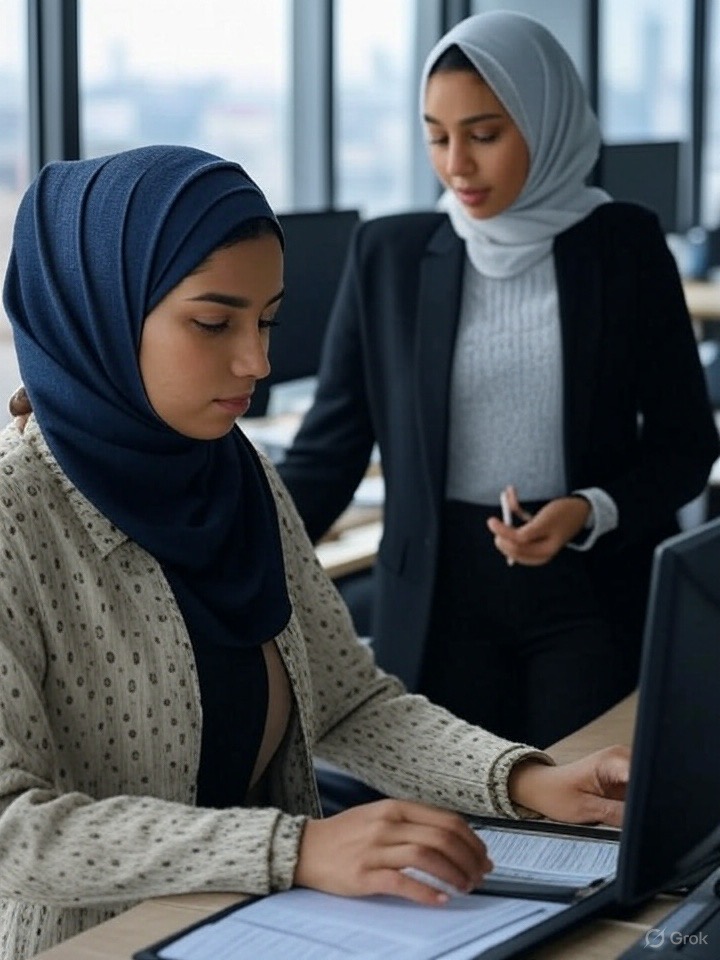
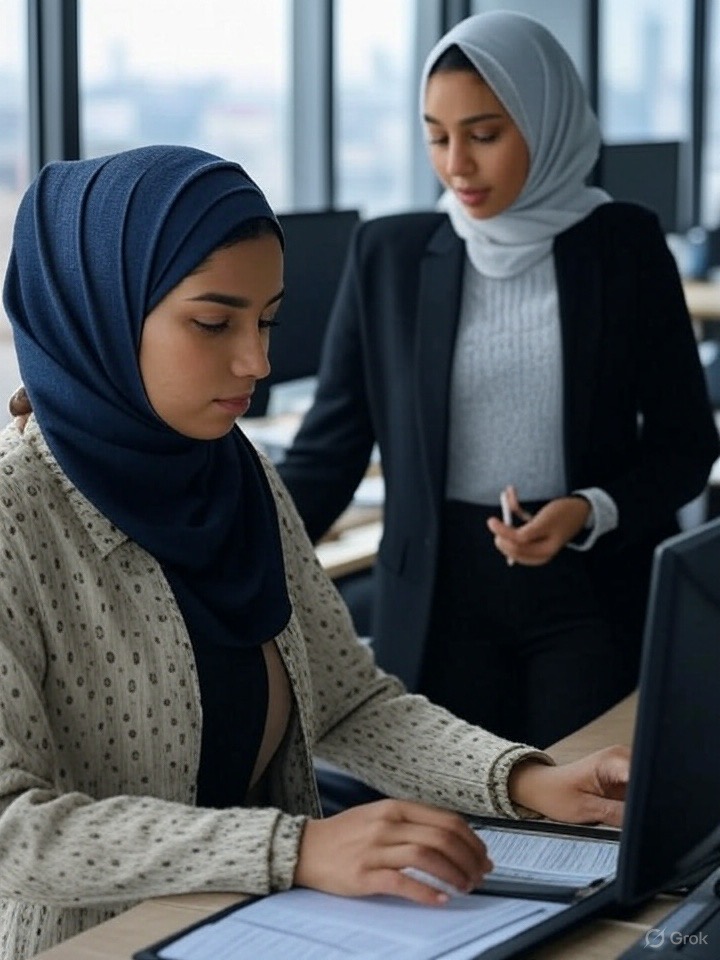
Why do muslim women wear hijabs | Beyond the Veil:

Why do muslim women wear hijabs
Why do muslim women wear hijabs | beyond the veil
Why do muslim women wear hijabs | beyond the veil “Image created with AI”

💼 Beyond the Veil:

Muslim Women Revolutionising Hybrid Workspaces with Faith and Flexibility

Islam has a clear view on women working and being financially independent. What the Quran says:

“For men is a share of what they have earned, and for women is a share of what they have earned” (Quran 4:32). 

This divinely commanded economic agency emerged in early Muslim society through leaders such as Khadijah (RA), a merchant who employed Prophet Muhammad (before the Prophethood) and oversaw trade between countries, and Shifa bint Abdullah (RA), who was appointed by Caliph Umar (RA) to manage the markets in Medina. These examples from the past disprove the idea that religion and work are incompatible in today’s world.

Why do muslim women wear hijabs:

How to Deal with Hijab Discrimination: How to Balance Faith and Prejudice

Studies show Western companies are less likely to call back people who wear hijabs (about 40% less likely).

“Allah does not look at your appearance but at your hearts and deeds” (Sahih Muslim 2564c).

Faith-Driven Solutions in Action:

Hijab-Friendly Business Rules: Dress rules that include people of all faiths are used by 

Companies like Microsoft and Dow.

Spiritual Resilience: Internalising Quran 49:13: “The most noble of you are the most righteous” is a way to build spiritual strength.

Table: Hijab Discrimination Response Framework

ChallengeIslamic PrincipleAction Strategy
Biased HiringDivine worth in taqwa (Q49:13)Document incidents; pursue legal redress
Workplace MicroaggressionsPatient perseverance (Q16:127)Faith-sensitivity training advocacy
Promotion BarriersJustice advocacy (Q4:135)Mentorship programs for Muslim women

🌐 Faith-Friendly Remote Work: Islamic Wisdom Meets Digital Innovation

Why do muslim women wear hijabs
Why do muslim women wear hijabs. Picture by pexels:

Prophetic Precedent for Flexibility

Signs of the Future for Flexibility

Strategic flexibility is a key idea in hybrid work, and the Treaty of Hudaybiyyah is a great 

example of it. Some modern options are:

Digital Prayer Platforms: “PrayerSpace” and other apps sync work blocks with prayer times.

Virtual Modesty Zones are meeting rooms in VR where characters respect the hijab’s edges.

Productivity Frameworks in the Quran: Using the “gentle speech” in Quran 20:44 in internet conversations. Endorsements from Scholars:

Scholarly Endorsements:
Modern fatwas allow working from home when it:

Keeps family responsibilities in check.

 Keeps things from mixing too much 

 Sticks to Islamic morals when doing business.

Through instances such as Khadijah’s (RA), Muslim women have consistently demonstrated that their faith enhances their labour capabilities rather than impedes them. Their unique concepts are founded on the Quran’s justice and the wisdom of the Prophets, rendering their workplaces sacred. The act of Sacred defiance is exemplified by every policy that promotes justice, every design that respects human dignity, and every honest conversation.

“When Allah makes your job easier, accept the tools He gives you” (adapted from Musa’s prayer, Quran 20:25-28).

 👗 Modest Fashion Tech: Where Giving People Power Meets Entrepreneurship

Revolutionising a Business

Muslim women are in charge of a $300 billion market for modest clothing, thanks to new ideas like

Smart fabrics

Smart fabrics include hijabs that control body temperature and have sensors built in.

Virtual Try-On:

Virtual Try-On: Tech: fitting rooms driven by AI that respect modesty

Blockchain Transparency: 

Blockchain Transparency: Apps that check the halal production chain

Why do muslim women wear hijabs:

Why do muslim women wear hijabs | beyond the veil
Why do muslim women wear hijabs | beyond the veil, “Image created with AI”

Foundations for Business in the Quran:

The Quran (4:32) recognises women’s economic agency.

And do not crave what Allah has given some of you over others. Men will be rewarded according to their deeds and women ˹equally˺ according to theirs. Rather, ask Allah for His bounties. Surely Allah has ˹perfect˺ knowledge of all things.

This is in line with Quran 2:195, which says, “Do not throw yourselves into destruction” through exploitative labour.

A Quranic Framework for Balancing Work and Life

“Allah does not burden any soul beyond its capacity” (Quran 2:286) 

Examples of real-world applications are:

Flexible scheduling: planning work around prayer and family time with permission from the boss

Micro-sabbaticals: Taking 15-minute breaks at work to read the Quran

Family-Centric Entrepreneurship: Home-based businesses that keep the peace at home, 

In line with the Prophet’s (PBUH) focus on motherhood 

Scholars say that work-related activities must:

1-Not ignoring main parental roles when it’s appropriate.

 2- Be humble when you’re using technology. 

3- Do something good for the community (maslaha). 

 Conclusion: 

The Quranic energy is shown in the hybrid workspace change led by Muslim women:

“Allah does not change a people’s condition until they change themselves” (Quran 13:11) 

From Khadijah’s (RA) Camels to digital startups, Muslim women continue to show that their faith doesn’t hinder their work; it enhances it. By basing new ideas on the justice in the Quran and the wisdom of the Prophets, they turn workplaces into places of worship. Every honest email, every design that respects human dignity, and every policy that fights for fairness becomes an act of holy resistance.

FAQ:Beyond the veil

1- Does the hijab have to be worn in Islam?

A-Yes, according to the Quran (24:31) and the Hadith (Sahih Bukhari 4481), both of which are reliable sources. A lot of scholars agree on this, and all four Sunni madhabs agree on it for women over the age of puberty.

2-Why do Muslim women wear the hijab if it’s “oppressive”?

A-Hijab means freedom, not oppression:
Does not agree with making women too sexual (Quran 33:33)
Attention is now turned to intelligence and character (Hadith: “Allah values your piety, not your appearance” – Muslim 2564)
Allows for greater control over how one looks: 81% of hijabis in Western countries say they wear them voluntarily (Pew Research 2023)

3-Changes are allowed by scholars under certain conditions:

A-Medicine: In an emergency, they can help male patients.
For sports and firefighting, special modest outfits are needed.
Never just for ease of use or social pressure (Quran 33:59).

4-How do hijabis respond to workplace discrimination?

A-Strategy. Islamic Basis.

Legal action Quran 4:135 (“Stand firmly for justice”)
Entrepreneurship Following Khadijah’s (RA) business legacy

Education campaigns Prophet’s (PBUH) dialogue with non-Muslims

The Role of “Muslim Women” in Modern Society

Muslim women-islam’s perspective on education and careers

The Role of Muslim Women in Modern Society: Islam’s Perspective on Education and Careers

Muslim women-islam’s perspective on education and careers
Muslim Women-Islam’s Perspective on Education and Careers “Image created with AI”

Islam’s Perspective on Education and Careers

Islam has always encouraged men and women to seek knowledge, help society, and reach perfection in their fields. Unlike common belief, Muslim women are not forbidden from getting an education or working; in fact, Islamic history is full of examples of women who excelled as leaders, doctors, intellectuals, and businesspeople.

This page will go over:

Islamic Viewpoint on Women’s Employment and Education

Historical Cases of Muslim Women in Occupational Fields

Contemporary Muslim Women Shattering Stereotypes

What Ulama Scholars Say About Women Employed in Various Fields?

1. Islam’s Stance on Women’s Education and Employment

Muslim women
Muslim women “Image created with AI”

A-Quran and Hadith Encourage Seeking Knowledge

Allah says in the Quran:

“Read in the name of your Lord who created—Created man from a clinging substance. Read, and your Lord is the most Generous—Who taught by the pen—Taught man that which he knew not.” (Quran 96:1-5)

This command applies to both men and women. The Prophet Muhammad (PBUH) also said:

“Seeking knowledge is obligatory upon every Muslim.” (Ibn Majah)

There is no distinction between genders when it comes to the pursuit of education.

B- Permissibility of Women Working in Islam

Islam allows women to work, provided:

  • The job does not conflict with Islamic ethics (e.g., no free mixing, no unlawful transactions).
  • Their primary responsibilities (if married or mothers) are not neglected.
  • The work environment is safe and respectful.

Many classical and modern scholars, including Sheikh Ibn Uthaymeen and Sheikh Yusuf Al-Qaradawi, have affirmed that women can work as doctors, teachers, engineers, and even in leadership roles if Islamic guidelines are followed.

2. Historical Examples of Muslim Women in Professions

A-Rufayda Al-Aslamiya – The First Female Muslim Nurse

In medical treatment, Rufaida Al-Aslamia (RA) played a leading role during the lifetime of the Prophet (PBUH). By setting up a mobile medical tent to help wounded soldiers in battle, she was one of the first female physicians in Islamic history.

B. Sutayta Al-Mahamili – A Renowned Mathematician and Scholar

She was a Muslim woman of the tenth century, renowned for her knowledge of Hadiths, mathematics, and legal theory. Respected academically in Baghdad, she demonstrated that women excelled in STEM disciplines long before current times.

C. Shifa bint Abdullah – A Female Judge and Administrator

Caliph Umar (RA) assigned her to be a market inspector (Muhtasib), in charge of supervising business activity in Medina—a position needing a thorough understanding of Islamic law and economy.

3. Modern Muslim Women Breaking Stereotypes

Today, Muslim women are thriving in diverse fields, just like non-Muslim women, while maintaining their faith. Some notable examples:

A-Medicine & Science

  • Dr. Hayat Sindi (Saudi Scientist) – A biotechnologist and one of the first female members of Saudi Arabia’s Consultative Assembly.
  • Though she has cerebral palsy, Ghanaian software engineer Dr. Farida Bedwei is a top authority on mobile banking technology.

B- Aviation & Engineering

  • Captain Aysha Alhameli, UAE’s first female Emirati pilot, is proving that Muslim women can succeed in sectors dominated by men.
  • Turkish scientist Elif Bilgin won prizes for developing bioplastic from banana peels at just 16.

C- Politics & Leadership

  • Former Pakistani PM Benazir Bhutto is the first woman to run a nation with a majority of Muslims.
  • U.S. Congresswomen Ilhan Omar and Rashida Tlaib are tearing down Western political boundaries.

4. What Islamic Scholars Say About Women Working

Muslim women
Muslim women “Image created with AI”

Many modern academics advocate women pursuing several professions as long Islamic rules are followed:

A-Sheikh Yusuf Al-Qaradawi

“Islam does not prevent women from working, but it sets conditions to protect their dignity. She can be a doctor, teacher, engineer, or even a judge in some cases.”

B- Al-Azhar university scholars

“There is no Quranic verse or Hadith that bans women from working. Khadijah (RA) was a businesswoman, and Aisha (RA) was a scholar—both had public roles.”

Al-Azhar scholars have issued rulings stating that women can work in medicine, education, journalism, and technology, as long as:

  • The job serves a societal need.
  • Proper Hijab and modesty are maintained.
  • Family obligations are not neglected.

5. Balancing Faith and Professional Life

Muslim women today face the challenge of balancing career ambitions with Islamic values. Here’s how they can maintain this balance:

A-Choosing a Halal Career Path

  • Opt for fields that benefit society (e.g., medicine, education, social work).
  • Avoid jobs involving interest (riba), gambling, or unethical practices.

B- Maintaining Modesty in the Workplace

  • Wear a proper Hijab (if applicable).
  • Avoid unnecessary free-mixing (khalwa).
  • Set professional boundaries while remaining respectful.

C- Prioritizing Family Without Sacrificing Ambitions

Muslim women-mother
Muslim women-Mother “Image created with AI”
  • Islam allows flexibility—women can work part-time or remotely if needed.
  • Husbands and families should support a woman’s career if it 

Conclusion: Islam Empowers Women to Excel

Women are permitted to work in medicine, aviation, engineering, and leadership positions under Islamic law. Instead, it establishes the groundwork for people to achieve through respect and faith. From historical luminaries like Rufaida al-Aslamia to modern pioneers like Dr. Hayat Sindi, Muslim women have demonstrated that faith and professional success are closely intertwined.

What is the most important thing? Muslim women, like non-Muslim women, have the right to pursue their dreams while adhering to Islamic principles.

Does Islam let women be engineers, pilots, or doctors?

Indeed, Islam allows women to pursue any legal ( Halal) career—including medical, aviation, engineering, and leadership—provided the employment follows Islamic standards (e.g., no free mixing, modest clothes, and no participation in haram activities like interest-based finance). Scholars like Sheikh Yusuf Al-Qaradawi and Dr. Zakir Naik confirm this, citing successful businesswoman Khadijah (RA) and first Muslim nurse Rufayda Al-Aslamiya (RA).

 Under what circumstances might Muslim women be employed outside of their homes?

Observing Hijab and avoiding pointless engagement with non-mahram men helps one to be modest.
If married or a mother, family obligations should not be compromised; there is no neglect of main responsibilities.
Halal income: The employment cannot include haram components—that is, alcohol, gambling, or immoral behavior.
Scholars both old and new, including Al-Azhar University, support these requirements.

 Exist any historical records of Muslim women serving in professional capacity?

Surely! Islamic history notes some trailblazing women including:

First Muslim nurse and field medic Rufayda Al-Aslamiya (RA)
Tenth-century mathematician and scholar Sutayta Al-Mahamili
Caliph Umar(RA) designated Shifa bint Abdullah as a judge and market inspector.
These illustrations show how actively Muslim women have always been involved in government, medicine, and education.

 How may contemporary Muslim women strike a balance between Islamic principles and employment?

Islamic feminism

Many get balance by:
Selecting flexible jobs could be remote work, part-time employment, or surroundings appropriate for women (such as all-women hospitals or colleges).
Family comes first. Including relatives and partners in child care helps to keep balance.
Maintaining a grounded in faith basis from regular prayer, Quranic study, and community support.
Modern role models in this harmony are scientist Dr. Hayat Sindi and pilot Captain Aysha Alhameli.


The Mahr-Dowry Dichotomy:

The mahr-dowry dichotomy
The mahr-dowry dichotomy:

The Mahr-Dowry Dichotomy: How South Asian Muslims Betrayed Islamic Principles of Marriage

The Mahr-Dowry Dichotomy: In the life of Southern Asian Muslim (India, Pakistan, and Bangladesh) weddings—with their colorful mehndi rituals, enjoyable dholak ceremonies, and serious marriage rituals—a troubling contradiction persists. Regardless of Islamic teachings, which celebrate a monetary gift called Mahr given to the bride by the groom, many Muslim families in India, Pakistan, and Bangladesh have adopted the non-Islamic practice of dowry, in which the bride’s family provides substantial gifts, money, or property to the groom’s family.

The South Asian Paradox: Mahr in Theory, Dowry in Practice

This practice has not only rejected Islamic marriage but has also become a source of excessive monetary pressure and exploitation for women in particular. While mahar represents the empowerment of women through Islam, dowry is a symbol of their oppression—yet both coexist in a complex relationship that reveals the tension between religious ideal and cultural reality in South Asian Muslim communities.

Understanding Mahr vs. Dowry: Fundamental Differences

What is Mahr?

In Islamic jurisprudence, Mahr (also called Mehr) is a mandatory gift, financial security, or commitment paid by the groom to the bride as an essential component of the Muslim marriage contract. Unlike dowry, Mahr is explicitly required by Islamic law and serves as a form of protection and respect for the bride. The Quran states: “And give the women upon marriage their dowries graciously” (Quran 4:4). Mahr can be in the form of cash, jewelry, property, or even non-material gifts such as teaching verses from the Quran Crucially, it becomes the exclusive property of the bride, providing her with financial autonomy and security within the marriage

What is Dowry?

As part of the marriage contract, the bride’s family provides gifts, money, or land to the groom’s family. This procedure is called dowry. This custom, which is not required by Islamic law, comes from South Asian customs and has been criticized for using women as property and causing abuse, debt, and even violence against brides.In places like India and Pakistan, dowry is against the law, but it is still a common practice.

The mahr-dowry dichotomy

Table: The Mahr-Dowry Dichotomy: Key Differences Between Mahr and Dowry

AspectMahr (Islamic)Dowry (Un-Islamic)
Direction of FlowGroom to brideBride’s family to groom’s family
Legal/Religious StatusReligious requirement in IslamCultural practice, illegal in many countries
PurposeBride’s financial securityStatus symbol, family compensation
RecipientBride exclusivelyGroom and his family
Islamic BasisQuran 4:4, HadithNo Islamic basis, pre-Islamic custom

The South Asian Paradox: Mahr in Theory, Dowry in Practice

In contemporary Southern Muslim communities, a contradictory situation has arisen where mahr and dowry exist together, often with disastrous consequences for the bride and her family. While couples fulfill some of the religious requirements of the mahr—often by providing a spiritual amount such as the Qur’an or minimalistic documents—they also negotiate wider discussions about dowry that can include cars, apartments, clothing, and large cash amounts. This contradiction is particularly noteworthy because Islamic marriage was fundamentally designed to eliminate un-Islamic practices in which women were considered property.

The Holy Prophet Muhammad (PBUH) rejected the idea of ​​practices like dowry and established mahr as a system to respect the dignity and personal rights of women. Despite this, today’s Southern Muslims continue to practice dowry in various forms, such as “gifts,” “voluntary contributions,” or “family assistance,” while reducing it to a mere spiritual formality. Underestimating the problem will not lessen its gravity. For families with many daughters, the financial burden of dowry can be very heavy, often forcing the parents to take loans, pledge assets, or spend lifelong savings. Meanwhile, the Mahr should work as a primary financial transfer.

Factors Perpetuating the Practice

Socioeconomic Factors and Status Anxiety

Muslims in South Asia have been paying dowries for a long time, which shows that they are worried about their social standing and are competitive for social places. In places like Pakistan and India, where marriage is a way to move up in society and improve your family’s image, huge dowries are a clear sign of status. Middle-class people who want to move up the social ladder through marriage will find these points to be especially true.

Cultural Assimilation and Normalization

During the cultural coexistence that has gone on for centuries in South Asia, there has been a mutual exchange of practices among different religious communities. The Muslims who were historically involved in the dowry practice and lived close to the Hindus and Sikhs gradually adopted this practice despite its incompatibility with Islamic principles. As a result of this modernization, many South Asian Muslims now consider the gift an essential part of their labor traditions, rather than a foreign-imposed form.

Countries like India and Pakistan do have dowry laws, but their enforcement is still weak, especially in Muslim communities, where personal matters are often given priority. The legal systems in these countries—where Islamic laws are applied to the personal matters of Muslims—create loopholes that allow the dowry system to continue despite legal restrictions.

Patriarchal Interpretations and Female Internalization

The practice of dowry has sometimes been justified through patriarchal interpretations of Islamic texts. Some religious leaders have either refrained from commenting on the matter or have established new justifications for dowry because they are influenced by cultural norms rather than authentic Islamic sources. In this context, socialized women often internalize these atrocities, view dowry as necessary for their daughters’ marital success, and perpetuate the practice themselves.

Consequences for Women and Families

When the mahr and marriage systems are used together, they have bad effects on Muslim women and their families in the south asia:

The mahr-dowry dichotomy

Economic Vulnerability

The dowry puts a lot of financial stress on the bride’s family, and they often end up in a lot of debt. When families are poor, collecting dowries can ruin their finances. On the other hand, when families have many girls, it’s a constant problem that needs to be solved by years of saving and giving.

Domestic Pressures and Violence

When dowry expectations are not met—or when additional demands are raised after marriage—brides often face harassment, abuse, and even violence from their in-laws. Regardless of the issue, dowry killings and domestic violence related to dowry disputes are a frequent occurrence throughout Southern Asia, affecting Muslim women as well as Hindu and Sikh communities.

Psychological concerns

Talking about dowry all the time can be very stressful for women, who may feel like they are a “burden” on their families. This worry is made worse by the fact that they think a poor dowry could lead to rejection or bad behavior in their new homes as husbands.

Discussion of Islamic rights

Focusing on dowry weakens the protective functions of the woman, reducing it to a practical symbol rather than a meaningful physical protection. This discussion of rights represents a fundamental conflict with Islamic principles designed to empower women economically.

Reclaiming Islamic Principles: The Way Forward

To solve the marriage problem among South Asian Muslims, we need to do more than just teach them about religion. We also need to change the law and make changes in society.

Religious Education and Leadership

Dowry is not permitted in Islam. Religious leaders and educators must clarify and emphasize how important the Mahār is for safeguarding the brides’ wealth. Following the path of the Prophet Muhammad (peace be upon him) who emphasized simple marriages with Mahār, mosques, Islamic centers and marriage officials should not participate in weddings where dowry is exchanged.

South Asian governments need to make sure that anti-dowry rules are strictly enforced and that they are the same for all religious groups. For that matter, judicial systems should see Mahr as a real financial right, not just a formality. 

Help and Community Initiatives

In Muslim communities, grassroots groups should start efforts to let people know what Islam says about dowry and Mahr. Couples could learn about their Islamic rights and duties through premarital counseling programs, and community support networks could offer alternatives to dowry-based matchmaking.

Empowerment of Women

Women can fight for their Islamic rights, like good Mahr, by learning more about religion and getting more financial freedom. When women know that Islam doesn’t require dowry and that Mahr is their legal due, they are better able to stand up to cultural pressures. 

Progressive Examples and Models

Some communities have started developing alternative models that emphasize Islamic values ​​rather than cultural practices. For example, some couples now proudly declare their marriages to be “dowry-free” and ensure they provide adequate resources for the mahar. These examples should be celebrated and promoted in Muslim communities.

The Mahr-Dowry Dichotomy

The practice of dowry among Southern Muslims represents a worrying victory of culture over religion and patriarchy over principles. While Islam provided economic rights and protection to women through dowry, other cultural practices have overturned the system and forced women and their families to bear the economic burden. This contradiction not only conflicts with Islamic teachings but also upholds the very practices that Islam sought to eliminate.

Conclusion:

To win back the Islamic views of marriage, a bold attempt to reconcile practice with principles is required—rejecting dowry in all its forms and adopting the true sentiment of the mother as a system of justice, respect, and empowerment for women. This change will not be easy, as it challenges deeply ingrained social norms and economic structures. But it is necessary if Southern Muslims want to remain faithful to their religious values ​​while also ensuring respect and safety for all their citizens, especially women.

Its solution begins with the recognition that mahar and dowry are fundamentally incompatible—one empowers women, the other burdens them; one is confirmed by God, the other is determined by man. By prioritizing Islam over culture, principles over practices, and justice over convenience, South Asian Muslims can restore the respect that their religion originally provided to women and create marriage practices that genuinely uphold Islamic values.

FAQ: The Mahr-Dowry Dichotomy

1. What’s the difference between dowry and mahr?

A: Mahr: A gift or promise of money that the groom has to give to the bride. According to Islam, it is hers alone, and she must provide her with financial protection and respect. It is an important part of the Islamic marriage contract, or Nikah.
Dowry is money or gifts given by the bride’s family to the groom’s family. It is a custom from before Islam that has nothing to do with Islamic law. It treats the woman like a burden and is against the law in places like India and Pakistan.

2. If dowry is un-Islamic, why do so many South Asian Muslims practice it?

A: Cultural assimilation, class anxiety, and patriarchal norms are some of the reasons why the practice continues. Over hundreds of years, the practice has become so common that many groups see it as an important part of their culture and often put it ahead of Islamic beliefs. A big reason is that they are afraid of being judged by others and have a hard time finding a “suitable” match without paying a fee.

3. Why don’t more Islamic clerics and scholars speak out forcefully against dowry?

A: This is a complicated matter. Some common reasons are:
Normalization in culture: Some clerics come from the same culture and may see it as a social problem instead of a religious one.
Fear of Retaliation: Criticizing dowry can make strong people in the community who support it dislike you.
Male Blind Spots: The same male way of thinking that helps the dowry system can also affect religious groups.
Focus on Rituals Over Social Justice: Some people may teach about rituals (like fasting and prayer) more than social and cultural evils.

4. What does Islam actually say about dowry?

A:Getting or giving a dowry is completely forbidden in Islam. Prophet Muhammad (peace be upon him) set up a simple way for people to get married. The groom pays the girl the Mahr. In Islam, marriage should be fair and simple. Any practice that makes the bride’s family pay extra money or treats the woman like a product is not in line with this.

5. Is a small, symbolic Mahr sufficient if a large dowry is given?

A: Not at all. In order to make big dowry deals possible, lowering the Mahr to a small amount is against Islamic law. Mahr’s goal is to give the bride real financial security, but this goes against that goal. The main attention should be on a good Mahr, not on a dowry to make up for it.

6. What are the consequences of the dowry system?

A: The results are bad and affect many people:
The bride’s family is in terrible debt, which is ruining their finances.
Threats of violence and abuse: Brides may face threats of violence, harassment, or even “dowry deaths” if their requests are not met.
Psychological Distress: Women who feel like they are a burden to others.
Erosion of Rights: Undermining the Islamic right for women to Mahr, which gives them power.

7. What can I do if my family is pressuring me to participate in dowry?

A: Instruct your family on the concept of Mahr and the prohibition of dowries in Islam with a compassionate approach.
Seek Assistance: Consult with your family alongside a knowledgeable imam or community leader familiar with Islamic principles.
Articulate your Islamic position clearly and respectfully. Adhere to Allah’s commandments above cultural customs that displease Him.
Identify Individuals Who Align with Your Perspectives:Seek a partner and family that share your Islamic views and reject the practice of dowry.

8. What is the solution? How can we end Dowry practice?

A:There are several things that need to be done to end dowry:
Religious Education: Religious Education: Clergy should consistently reject dowries from the pulpit and throughout pre-marital counseling.
Community Leadership: Mosques and other groups should set up networks to help people find partners without dowries and honor couples who refuse to pay them.
Legal Enforcement: Governments must strictly enforce rules against dowry for all citizens, no matter what religion they are.
Individual Courage: Muslims must be brave enough to act in line with their faith, put Mahr first, and refuse marriage, even if it goes against what other people expect of them.