
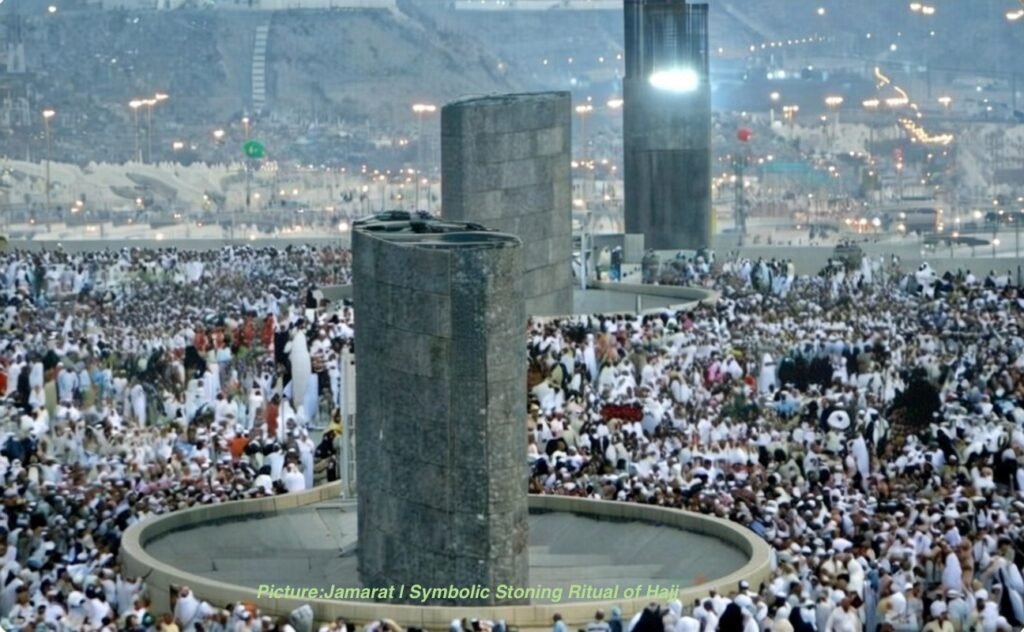
Jamarat | Symbolic Stoning Ritual of Hajj 2026
Jamarat | Symbolic Stoning Ritual of Hajj 2026: Learn about the deep meaning of the Jamarat ritual during Hajj, including its historical roots, spiritual importance, how it works today, and what this stoning means to millions of Muslims around the world. In one of Islam’s most powerful events, you can see how old customs meet modern practices.
Table of Contents
Jamarat : More Than Stones
Millions of people dressed in simple white clothes gather every year in a valley in Mina, Saudi Arabia, for the Islamic journey of Hajj. They carry small stones, and the look on their faces shows that they are determined. The Jamarat, which looks like easy stone throwing, is actually one of the most complicated rituals in Islam. By doing this, modern believers are linked to a story that happened almost 4,000 years ago. Simple pebbles are turned into symbols of spiritual resistance and moral belief.
The Story Behind the Stones: Abraham’s Trial
We need to look back to the shared Abrahamic faith in order to understand the Jamarat. According to Islamic history, Prophet Ibrahim (Abraham) had to deal with an impossible test: God told him to kill his son Ishmael as an offering. The story says that as he was about to respond, Shaitan (Satan) appeared to him three times: first to try to stop him from doing what God told him to do, then to tempt his wife Hajar (Hagar), and finally to tempt Isma’il himself.
Each time, Ibrahim hit the devil with stones as a response. In Mina, three pillars are ritually stoned to represent the three sins he steadfastly refused to give in to. The word “Jamarat” comes from the Arabic word “jamrah,” which means a small rock or fire. This word evokes both the stones and the “burning away” of temptation.
The Numbered Pebbles
There are many small details in the routine, and each one has a special meaning. During the twelve-day pilgrimage, pilgrims typically collect seventy pebbles: twenty-one for the eleventh day, twenty-one for the twelfth, and seven for the tenth. To be prepared, pilgrims often gather an additional twenty-one pebbles. This is to prevent losing any and to emphasize the importance of completing the ritual correctly. This careful approach reflects the Prophet Muhammad’s (PBUH) own practices, which have been followed for centuries.
Abdullah Ibn Abbas told a beautiful story about how important it is to stay devoted: “The Prophet (PBUH) sat al-Fadl behind him on his mount, and al-Fadl said that he did not stop reciting the Talbiyah until he stoned the Jamrah.” (1685 in Sahih al-Bukhari and 1282 in Sahih Muslim). This shows how remembering Allah in the heart (through the Talbiyah’s chant of “Labbayk Allahumma Labbayk”) flows into the act of rejecting someone physically, bringing purpose and action together.
The Three Pillars: Structure, Sequence, and Sunnah
Structure, Sequence, and Sunnah are the three pillars. At the Jamarat site, there are three separate buildings, each stoned in a certain order that shows Ibrahim’s trial:
Jamarah al-Sughra or Jamarah-al-Oola (The Small Pillar):
Jamarah al-Sughra (The Small Pillar): The Small Pillar is where Satan first tried to tempt Ibrahim.
Jamarah al-Wusta (The Middle Pillar):
Jamarah al-Wusta (The Middle Pillar): The Middle Pillar is where he tried to tempt him again. Drawing the desire of Hajar
Jamarah al-Kubra (The Large Pillar, also called Jamarat al-Aqaba):
Jamarah al-Kubra (The Large Pillar, also called Jamarat al-Aqaba):
The Large Pillar, also known as Jamarat al-Aqaba, is part of Jamarah al-Kubra. It stands for Isma’il’s challenge.
Another story from Abdullah Ibn Abbas keeps the Prophet’s (PBUH) exact method alive and serves as a timeless example: “He went to the biggest Jamrah and put the House (the Kaaba) on his left and Mina on his right. Then he stoned it with seven pebbles and said, “This is how the person to whom Surah Baqarah was given (peace and blessings of Allah be upon him) stoned it.” (1748 in Sahih al-Bukhari and 1296 in Sahih Muslim). When you carefully position yourself so that you face the Qiblah and the symbolic scenery of Mina, what you’re doing becomes a deeply situated prayer.
After deadly stampedes in the past few decades, these pillars were changed from simple structures to long walls (about 26 meters long) with basins below to collect stones. The development of architecture itself shows how to keep the essence of the Sunnah while protecting human life, which is a concept that is deeply rooted in Islamic law.
Dimensions of the spiritual: Devils inside and stones outside
Spiritual Dimensions: Inner Devils and Outer Stones
The Jamarat is physically aimed at pillars, but its real meaning is inside. Pilgrims today are told that each stone stands for:
Rejection of disobedience: Disobedience is not allowed: Fighting against what keeps us from living a good life
The bond was renewed: Making a new promise to follow God’s rules.
Together for a reason: Joining millions of people in a spiritual battle at the same time
A modern Islamic expert, Dr. Omar Suleiman, says, “When you throw those stones, you’re not just remembering how Ibrahim turned away from Satan.” You are ritually getting rid of the “satans” in your life, which are the bad habits, wants, and weaknesses that keep you from following your values.
The hadith literature backs up this internal reality. In one story, the Companion Jabir ibn Abdullah talked about how the Prophet (PBUH) behaved during the stoning. He said that the Prophet did it slowly and with calm solemnity, saying, “Learn your rituals from me.” (1297 in Sahih Muslim). This instruction makes it clear that the ritual is a way to learn, a way to prepare the body for the battle that the mind is always fighting.
Modern Logistics: Preserving the Sunnah in Safety
The New Logistics: Keeping the Sunnah alive in safety
After deadly crowd incidents in 1990, 1994, 1998, 2003, and most recently 2015, in which over 2,000 people died, the Saudi government made huge changes to the country’s infrastructure with the help of Islamic scholars who wanted to find a balance between custom and safety:
Multi-level bridges Bridges with more than one level let people walk between four floors
Emergency exits: There are fire doors every 20 meters.
Wider ramps: More steps and paths that are clearly marked
Digital crowd: tracking with alerts in real time
Extended throwing times:Longer throwing times from sunrise to sunset (and more lately, into the night).
These real-world steps are in line with the Islamic law principle of , which means “public welfare,” and the teachings of the Prophet, who said, “There should be neither harming nor reciprocating harm.” There are 2341 Sunan Ibn Majah. The changes allow the practice to continue while still upholding the faith’s highest duty to protect its followers. This means that millions of people can follow the Sunnah of the Prophet (PBUH) in safety and devotion.
Personal Pilgrim Accounts: The Human Experience
Personal Accounts of Pilgrims: The Human Experience
In 2022, Aisha, a traveler from Indonesia, said, “I thought it would feel hostile, but it made me feel free.” I named each stone after something I wanted to leave behind, like my short temper, my envy of other people’s success, or the way I was always getting sidetracked by small things. “The physicality made the commitment inside real.”
Environmental and Ethical Considerations
Based on the Islamic concept of stewardship (khilafah), there have been important discussions in recent years about how the ritual affects the environment. With about two to three million pilgrims throwing about 70 million stones every year, the police now:
Put pebbles that have been chemically cleaned and sterilized in certain places.
Use filtration devices to collect and reuse stones.
Use stones that have been taken away for building projects.
Tell pilgrims they can only bring the number that is allowed (49 or 70 total, based on the length of Hajj).
For example, the Prophet taught, “The world is beautiful and green, and truly God, the Exalted, has made you His stewards in it.” This concern for the earth comes from his teachings. (2742) in the Sahih Muslim.
Present-day interpretations: More than just words.
Contemporary Interpretations: Beyond Literalism
Also, some Muslim thinkers, like Dr. Khaled Abou Al Fadl, stress how important Jamarat is as a symbol. He says, “This ritual represents a strong protest against all forms of moral corruption, whether personal greed or systemic injustice.” Stones are not real weapons; they are a statement of spiritual freedom.
From this point of view, this rite is linked to the bigger fights going on in society today against materialism, oppression, and moral compromise. Based on how things are now, this fits with the Prophet’s plan.
That’s how stones that make things better, not worse came about.
Jarat shows a very different side of things in a society where throwing stones is often seen as a way to show disagreement. In this place, stones are used to strengthen the mind and the heart. Instead of hurting another person, they say, people should fight their small wants with the same accuracy and strength as Prophet Muhammad (PBUH).
In its entirety, the Jamarat ritual teaches that the most important battles are often fought within, that traditions can change without losing their meaning, and that simple actions can have huge meanings when done with purpose and in line with the Sunnah. When pilgrims return from Mina, they bring more than just memories with them. They also carry the belief that choosing faith over fear, principle over temptation, and devotion over distraction is an ongoing practice, just like the person to whom Surah Al-Baqarah was revealed taught us by his perfect example.
Frequently Asked Questions (FAQs):Jamarat | Symbolic Stoning Ritual of Hajj 2026
Q-1: Isn’t the stoning ritual violent or aggressive?
A: The ceremony does involve throwing, but it’s only symbolic. The pillars are symbols of temptation, not people. The action represents spiritual rejection rather than physical harm; it’s more like “casting away” bad influences than attacking. Hadith record that the Prophet (PBUH) was cool and solemn during the stoning, which shows that it was not an aggressive act.
Q-2:Why are there seven pebbles in each pillar?
A: The number seven is based on the clear Sunnah of the Prophet Muhammad (PBUH), which is mentioned in many trustworthy hadiths. In Islamic tradition, the number seven often means completion or perfection, and in this case, it exactly fits the pattern set by the Prophet (Ittiba’ al-Nabi).
Q-3: Do the stones need to hit the pillars?
A: The intention (niyyah) is more important than the truth. As you throw, your spiritual attention should be on consciously turning away from temptation with each throw. They say that you should try to land the stones in the basin, but if you miss, the ritual is still valid as long as you did it with the right purpose.
Q-4: What changes has technology made to the ceremony while still keeping the traditions alive?
A: The core actions of the practice haven’t changed from what the Prophet (PBUH) taught, but technology has made it safer by keeping an eye on the crowds, providing air-conditioned paths, digital signs in multiple languages, and pilgrims’ apps that help them find their way.
Q-5:Why is it a good idea to keep doing the Talbiyah until the killing starts?
A: As shown by the story of al-Fadl riding behind the Prophet (PBUH), continuing the Talbiyah keeps you in a constant state of worship and devotion to God, connecting all the practices of Hajj into a single stream of worship. It stands for the heart’s constant connection with God, even when doing hard things for the body.
Q-6: What happens to all the stones afterward?
A: Stones that are collected are cleaned, germicidal, and often used again for building in Saudi Arabia. This follows the Islamic principle of not throwing things away and caring about how they affect the earth. It also keeps the ritual space clean and honorable for future pilgrims.