
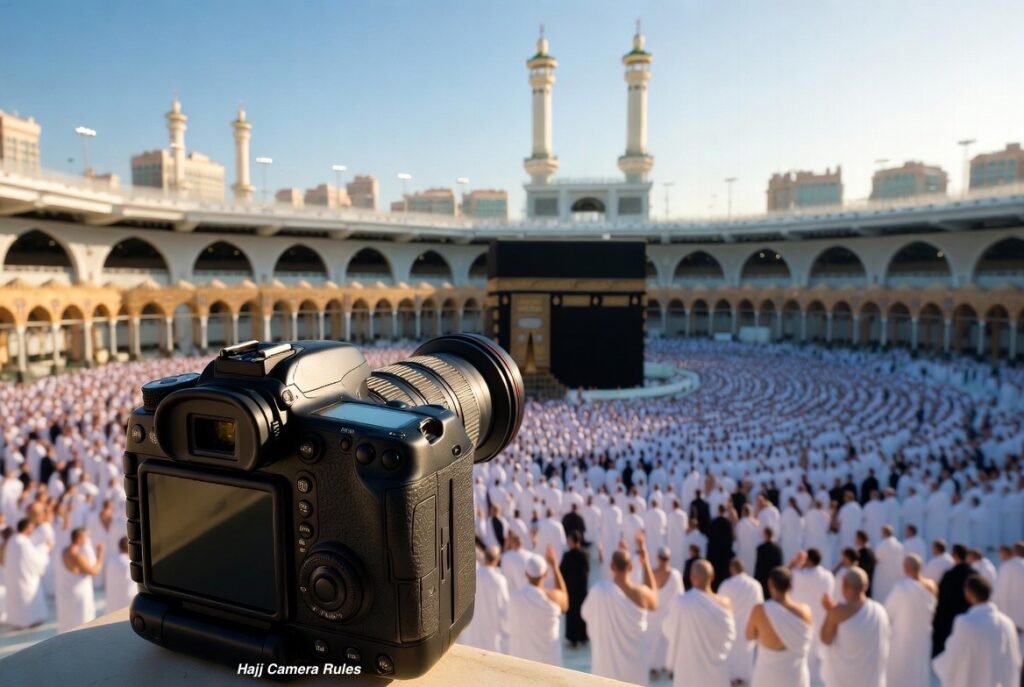
Hajj Camera Rules:
Hajj Camera Rules: New camera regulations for Hajj 2026 in Madinah and Makkah. Find out where you are and aren’t allowed to take photos, and how to prevent your camera from being confiscated or receiving a fine on your travels.
Hajj 2026 Camera Rules Complete Guide for Pilgrims
As development progresses on Hajj 2026, the Saudi government has implemented tougher regulations to safeguard the spiritual essence, safety and sanctity of the journey. One of the most noteworthy changes is the stringent ban on photography and filming inside the two holiest structures of Islam, Al-Masjid al-Haram in Makkah and Al-Masjid an-Nabawi in Madinah.
The new rules apply to all pilgrims, regardless of nationality, and cover both professional equipment such as DSLR cameras and everyday equipment such as smartphones. It is crucial to know these restrictions before you go out on your trip so that you don’t have to deal with additional stress, fines, or hassles throughout your Hajj.
Why the Ban Has Been Introduced
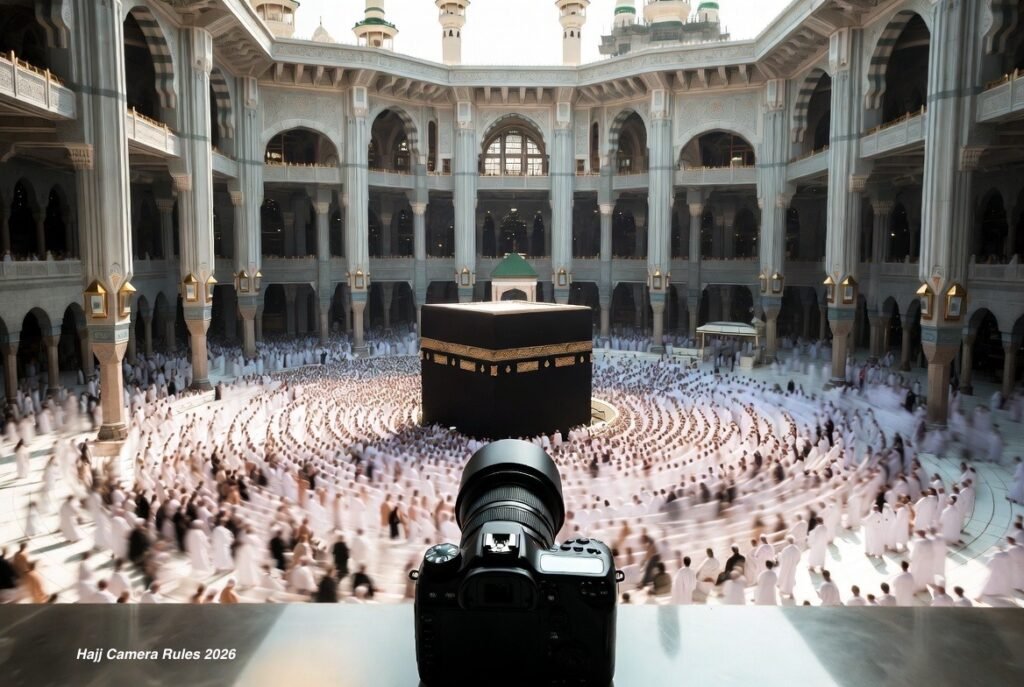
Hajj Camera Rules
The main reason for the photography ban is to protect the spiritual atmosphere of Hajj. Millions of people come to Makkah and Madinah every year to have a highly personal and holy experience. Too much photography is becoming a bigger problem because it takes people’s attention away from prayer.
The government wants to make sure that pilgrims stay focused on their ibadah and don’t use the holy places as tourist spots. Peace of mind is another important reason. A lot of pilgrims would rather not be taken when they are deeply praying, thinking, or feeling emotionally open.
There are also issues of safety and managing crowds. Large cameras, tripods, and recording equipment can block paths, make it hard to move around, and put people’s safety at risk in places that are already crowded.
Where Photography Is Strictly Prohibited
When it comes to holy mosques and other important ritual places, the ban is especially strict. Some of these are:
Inside the Haram Mosque
Inside the Al-Masjid an-Nabawi
Tawaf places near the Kaaba
From Safa to Marwah, there is Sa’i.
Mount Arafat’s fields, Muzdalifah, and Mina during prayer times
No matter what, you are not allowed to take pictures or videos in these places. This is true for selfies, casual photos, and expert recordings all the same.
Security staff can step in even if you are only using your phone’s camera for a short time.
What Happens If You Break the Rules
The Saudi government has made it plain it would be strictly enforced. Security personnel are always verifying if all the major pilgrimage zones are following the guidelines.
Cameras in restricted places A pilgrim found with a camera in a restricted place may be:
Caution and instructions to halt immediately
Device examination
Removing tools temporarily or permanently
Major cases might lead to fines or other penalties
Professional gear such as DSLR cameras, lenses and tripods are very likely to be confiscated if brought into places that aren’t authorized.
The idea is not to punish the pilgrims but to ensure everyone obeys the guidelines and preserves the holy sites in good condition.
Are Cameras Allowed Anywhere During Hajj?
Hajj Camera Rules:
There are some places in Saudi Arabia where you can take pictures during Hajj. Taking pictures is usually okay in a number of places, as long as it is done properly and with care.
Some of these are:
Hotels and other places to stay
In Madinah and Makkah, there are public streets.
Transportation hubs and routes
Public areas set aside outside of mosque limits
Even in these places, though, visitors should still be polite. Don’t take pictures of people without their permission, particularly women, families, and children. Also, always follow any written signs or directions from the government.
Should You Bring a DSLR Camera?
It is not suggested that you bring a DSLR camera to Hajj in 2026.
Technically, you can carry it in places that don’t have rules against it, like hotels, but it’s very likely that you’ll break the law by mistake. Because of the physical demands, crowds, and constant movement between places, it is also not possible to manage professional equipment during Hajj.
For occasional personal use in allowed places, a smartphone is a better choice. Security guards are less likely to notice it because it is small, light, and not obvious. As long as it is used properly and not for taking pictures in restricted areas, that is.
Still, even if you have a phone, you should be very careful not to use it in places where it’s not allowed.
The Spiritual Perspective
A lot of Muslims only go on Hajj once in their whole lives. It’s more than just a trip; it’s a spiritual journey that changes you deeply.
It’s possible to see the rule against taking shots as an opportunity instead of a problem. The best way for travelers to focus on their worship is to get rid of anything that might get in the way.
Not a picture should be taken when you pray at the Kaaba or stand in Arafat. Those are times to live, feel, and remember in your heart.
A lot of experts say that being honest and focused on Hajj is more important than writing about it for other people.
Practical Tips to Avoid Problems
As you get ready for Hajj, remember these things to make sure everything goes well:
-Do not bring DSLR cameras or professional shooting gear with you.
-When you’re inside a mosque, put your phone away.
-Pay close attention to the signs and statements.
-Do what the security staff tells you without question.
-Only take pictures in places where it’s clearly okay to do so.
-Do not invade the privacy or hurt the feelings of other travellers.
Common Mistakes Pilgrims Should Avoid
A lot of people break the rules by accident because they aren’t aware of them. Here are some common mistakes:
-Taking quick selfies in the grounds of mosques
-Taking camera clips during Tawaf or Sa’i
-Using phones in private, thinking it’s okay to do so
-Bringing camera gear with you “just in case”
Even if it’s only for a short time or not on purpose, these acts can get the police involved.
Final Thoughts
The camera rules for Hajj 2026 are part of a bigger plan by the Saudi government to make the trip safer and more spiritual.
For Hajj, there are rules that are meant to protect what makes it unique. They might feel strict at first. This is not about taking pictures; it’s about پah, being humble, and having a connection with Allah.
If pilgrims understand and follow these rules, they can fully enjoy the experience without any fears or other things that might take their attention away.
In the end, the most important memories of Hajj are not stored on a computer, but in the heart, where they stay for a long time after the trip is over.
Disclaimer
The information provided in this article is for general guidance and informational purposes only. While every effort has been made to ensure accuracy at the time of writing, rules and regulations related to Hajj may change at any time based on instructions from the Ministry of Hajj and Umrah and other Saudi authorities.
Pilgrims are strongly advised to follow all official announcements, on-site signage, and instructions from security personnel during Hajj. The author and publisher are not responsible for any actions taken based on the information in this article, including any penalties, restrictions, or loss of personal belongings.
This content does not constitute official guidance, legal advice, or religious rulings. For the most accurate and up-to-date information, please consult your Hajj operator or relevant Saudi authorities before and during your journey.
FAQ: Hajj Camera Rules
Q1-Are cameras allowed during Hajj?
A- No, cameras are not permitted inside the major holy mosques during the Hajj. It is completely forbidden to take pictures or videos inside Al-Masjid al-Haram in Makkah and Al-Masjid an-Nabawi in Madinah. This covers both cell phones and professional cameras.
Q2-Can you take photos in Makkah during Hajj?
A-You can snap pictures in Makkah’s public spaces, like the streets and hotels, which are beyond the city limits. On the other hand, photography is prohibited during Tawaf and Sa’i ceremonies, as well as inside
Q3-Is photography allowed in Madinah mosque?
A-No, taking pictures inside Al-Masjid an-Nabawi is prohibited.When inside the mosque, pilgrims are expected to refrain from using their phones or cameras.
Q4-Can you use your phone camera during Hajj?
A-While phones can be used for communication, it is not permitted to use the camera feature in restricted places. During rituals and within sacred mosques, pilgrims should refrain from taking pictures or recordings.
Q5- What happens if you use a camera during Hajj?
A-Security officers may stop you, examine your equipment, and request that you remove any content if you use a camera in a restricted area. Equipment may be seized or penalties may be imposed in certain situations.
Q6-Are DSLR cameras allowed during Hajj?
A-It is not advised to use DSLR cameras during the Hajj. They may be seized if used in restricted locations and are more likely to be stopped by security, particularly in the vicinity of sacred places.
Q7-Why is photography banned during Hajj?
A-To preserve the spiritual environment and safeguard pilgrims’ privacy, photography is disallowed.The intention is to avoid distractions or tourist-like behavior in favor of worship.
Q8- Can you take selfies during Tawaf?
A-No, it is not permitted to take selfies during Tawaf. When performing ceremonies near the Kaaba, pilgrims should refrain from using their phones or cameras.
Q9-Where can pilgrims take photos during Hajj?
A-As long as they respect local customs and privacy, pilgrims are allowed to take pictures outside of mosques, on public streets, and in hotels.
Q10-Are there penalties for breaking Hajj camera rules?
A-Indeed, there may be repercussions for disobeying the regulations. Depending on the circumstances, they could include warnings, removing pictures, seizing equipment, or taking more action.