
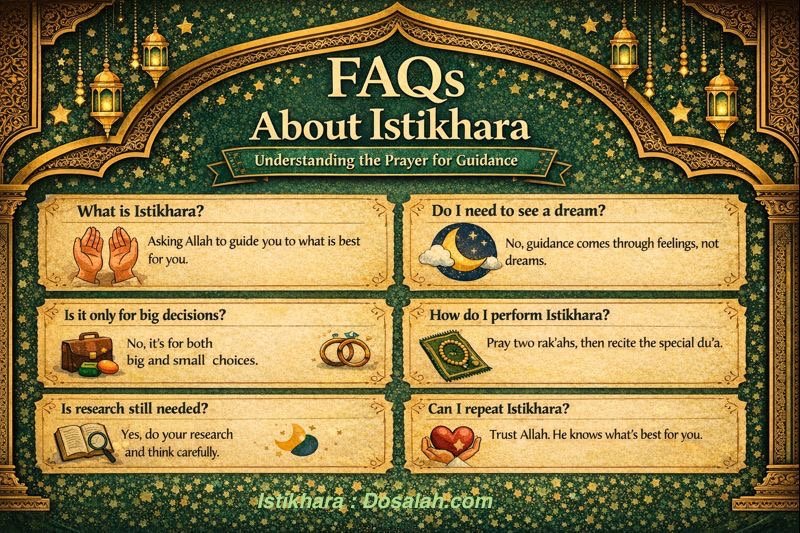
The Islamic prayer Istikhara is for divine guidance when you’re at a crossroads in your life.
Istikhara Spiritual Guide Making Important Choices: Find out more about the deep Islamic practice of Istikhara. Find out how this “Prayer of Seeking Counsel” gives Muslims the strength to make big choices by relying on Allah’s knowledge. Find out what the Quran says about it, the real Prophetic way from Sahih al-Bukhari, and a step-by-step guide on how to do it right.
Table of Contents
Istikhara: The Spiritual Guide for Making the Most Important Choices in Life
Istikhara Spiritual Guide Making Important Choices: People naturally look for a compass when they are at a crossroads in their lives, like when they are choosing a spouse, taking a job, making a big investment, or moving.
For more than a billion Muslims around the world, that guide is not something outside of themselves, but a personal, spiritual practice known as Istikhara. Istikhara, whose beautiful translations mean “seeking the best from Allah” or “Prayer of Seeking Counsel,” is more than just a rite. It is a deep act of surrender. It is the highest level of human effort and trust in Allah. It is a structured prayer in which the believer actively seeks to match their will with the Divine Decree, knowing that The All-Knowing sees what our limited vision cannot.
Istikhara is all about:
Istikhara is all about: its religious roots in the Quran, the exact way the Prophets did things as recorded in Sahih al-Bukhari, and how it can be used in real life to make big and small decisions with peace and confidence.
The idea behind it: the Quran gives us direction.
The exact prayer is explained in the Sunnah, but the Quran is where the heart of Istikhara beats. It’s the practical way to follow a basic Islamic principle: only Allah can give the best advice.
This constant state of seeking guidance is set by the first chapter of the Quran, Surah Al-Fatihah, which is read at the beginning of every prayer: “Guide us to the straight path.” (Quran 1:16)This repeated phrase is basically an Istikhara, which is a daily, hourly recognition that we are lost without divine direction.
Trust in Allah
In addition, the Quran combines human effort with trust in Allah. In Surah Al-Imran, it says, “And consult them in the matter.” This is a plan for making decisions. Once you have made up your mind, trust Allah. God really does love people who trust Him. (Quran 3:159)This verse describes the whole-person method in Islam:
1. Do research and talk to experts (Tashawur)—use your brain and get help from professionals;
2. Make a choice—use the wisdom God has given you;
3. Say the Istikhara prayer. This is the mental part of trusting Allah (Tawakkul). Istikhara is not a replacement for doing your work, but it is the holy end of it.
” The Almighty knows, but you don’t. (Quran 2:216)
In the end, Istikhara is based on the belief that Allah is completely aware of everything that happens and is wise. As it is said, “And it’s possible that you dislike something that is good for you and like something that is bad for you.” The Almighty knows, but you don’t. (Quran 2:216)The prayer is an honest acknowledgment of this verse. It asks Allah to put our needs aside for what He knows is better for our spiritual and physical health.
The Prophetic Blueprint: The Real Way from Sahih al-Bukhari
Istikhara’s rules for everyday life come straight from what Prophet Muhammad (PBUH) taught. The most reliable source is the collection of stories by Imam al-Bukhari in his Sahih, which is the second most reliable book after the Quran.
Jabir ibn Abdullah (r.a.) said, “The Messenger of Allah used to teach us the Istikhara for everything, just like he taught us a Surah from the Quran…” (Sahih al-Bukhari 1166).
This beginning is very deep.
This beginning is very deep. It was taught by the Prophet (PBUH) with the same care and focus as chapters of the Quran. This showed how important it is in a Muslim’s life.
He said: “When one of you is concerned about a practical undertaking, or about making plans for a journey, he should perform two Rak’ahs of voluntary prayer…”
In this way, the form is set: two optional units of prayer that should be done with focus and respect. Next, he taught the most important prayer:
“O Allah, I ask for Your help because You know everything and have the power to do it. I also ask for Your great bounty.” Because, yes, You decide, I don’t decide, and You know things I don’t know, because You know what can’t be seen.
O Allah, if You know that this matter is good for me in terms of my faith, my way of life, and the outcome of my affairs, then please make it happen and bless me. And if You know that this matter is bad for my faith, my way of life, and the outcome of my affairs, then take it away from me and keep me away from it. Instead, choose what is good for me wherever it is and make me happy with it.
This dua is a great work of both religion and science.
This dua is a great work of both religion and science. It starts with recognizing Allah’s qualities (Knowledge, Power, and Bounty) and our own flaws. Then it makes a broad request, looking for what is good not only for short-term gain but also for faith (Din), life in this world (Ma’ash), and the end result (Aqibah). It politely asks for either help and approval or a change of direction and satisfaction with a better option.
A Comprehensive Examination of the Proper Method for Performing Istikhara Prior to Conducting Istikhara: The Work of Individuals (Tashawur): Before you pray, do what you need to do in this world. Do some study, get some facts, and talk to experts and religious people you can trust..
Think about the pros and cons. Come up with a first impression.
The Prayer (Salah): Do two rak’ahs of free prayer at any time that is allowed, but try to avoid times that you don’t like. When you want to pray Salat al-Istikhara, that’s called niyyah. There is no set Surah to repeat; anyone can do so. However, for sincerity, it is best to recite Surah Al-Kafirun (109) and Al-Ikhlas (112) in the first and second rak’ah, respectively.
What the Prayer (Dua) Says:
What the Prayer (Dua) Says: Say the above-mentioned Istikhara dua right after the prayer is over, if possible while still sitting in the begging position. Importantly, when you hear this matter, say out loud or in your mind what you need. Please be clear and honest.
After the istikhara, recognizing the guidance: As a general rule, the answer doesn’t show up in dreams or other mysterious ways. Scholars say that after a true Istikhara, Allah guides your heart toward the choice that is good and away from the choice that is bad. This could show up as:
Having peace, clarity, or conviction about one choice, or, on the other hand, persistent unease about it.
The “opening” or “closing” of doors: things change, chances appear or disappear without warning, making the way clear.
Confirmatory advice from a source you can trust.
A feeling of happiness and relief from stress that lets you decide whether to move forward or give up without feeling bad about it.
Repeating: If you’re still not sure, you can say the Istikhara for up to seven nights, as some scholars say is right based on the general concept of persistent prayer.
Conclusion: Istikhara Spiritual Guide Making Important Choices
Istikhara Spiritual Guide Making Important Choices: Istikhara is a lot more than just a prayer for dealing with a problem. It trains the mind in Tawakkul (trusting Allah) and Rida (being happy with what He says). When a Muslim does Istikhara with sincerity, they turn any choice that makes them nervous into an act of worship. They will have a good result because the Prophet (PBUH) said that anyone who seeks Allah’s will will never be let down.
If someone believes in the All-Knowing, the Most Wise, who sees the end of everything from the start, they will always be able to move forward smoothly, even if the road they want to take gets blocked. Istikhara is still the believer’s constant anchor and guide in a world full of choices.
FAQ: Istikhara Spiritual Guide Making Important Choices
Q1-Is Istikhara only used to make big choices in life?
A: Not at all. Astikhara can be used for both big and small problems. It can be used for “everything” that you don’t know about, like marriage, jobs, travel, business choices, or anything else that makes you feel uncertain.
Q2- Does the Quran talk about Istikhara?
A: The Quran doesn’t say the exact words of the Istikhara prayer. But its meaning comes straight from the Quran, like asking Allah for help, trusting His knowledge, and depending on Him after making an effort.
Q3-Do I need to have a dream after Istikhara?
A: Not at all. A lot of people get this wrong. Most experts agree that dreams are not generally the best way to get direction. Instead, they say that peace of mind, clarity, or the opening and closing of opportunities are better.
Q4- How will I know that Allah has heard my prayer?
A: You might see:
Peace of mind toward one choice
Continued pain toward someone else
Situations getting better or worse
Getting advice from reliable sources
These are signs that will help you, not sudden wonders.
Q5- Does Istikhara have to be done with two rak’ahs?
A: Two optional rak’ahs are said before the dua in the Sunnah way. There are times when someone really needs to be able to pray, but they can still make dua. Prayer is the last part of Istikhara.
Q6- Is there a certain Surah that must be read during Istikhara?
A: No Surah has to be read. Many teachers, though, say that Surah Al-Kafirun should be read in the first rak’ah and Surah Al-Ikhlas should be read in the second. This is because they both have meanings related to being honest and trusting in Allah.
Q7- Is it possible to do Istikhara after making up your mind?
A: Yes. Even if you are moving toward one choice, you can still do Istikhara. The point is not to be confused, but to ask Allah to bless your choice if it is a good one and guide you if it is not.
Q8- Should I repeat Istikhara if I am still confused?
A: Yes. If uncertainty remains, it is permissible to repeat Istikhara over several days. Persistence in dua is encouraged in Islam.
Q9-Can someone else do Istikhara for me?
A: It is best to perform Istikhara yourself, because it is your heart, intention, and decision. Others may make general dua for you, but Istikhara itself is a personal act of worship.
Q10- Is Istikhara a substitute for research and planning?
A: No. Islam requires effort first. You should research, seek advice, and think carefully. Istikhara comes after effort, not before it.
Q11- What if the outcome is not what I wanted?
A:-That is the true test of Istikhara. It teaches trust and acceptance. What Allah chooses may feel difficult at first, but it carries long-term good that we cannot always see immediately.
Q12- Can Istikhara be done for sinful or forbidden matters?
A: No. Istikhara is only for permissible choices. Anything clearly haram does not require Istikhara, as Allah has already given guidance about it.
Q13-Is there a best time to perform Istikhara?
A: It can be done at any permissible time for voluntary prayer. Avoid the disliked times, such as right after Fajr until sunrise and after Asr until sunset.
Q14-What is the main purpose of Istikhara?
A: Its purpose is not just decision-making. It trains the heart to rely on Allah, accept His wisdom, and remain calm even when outcomes change.