
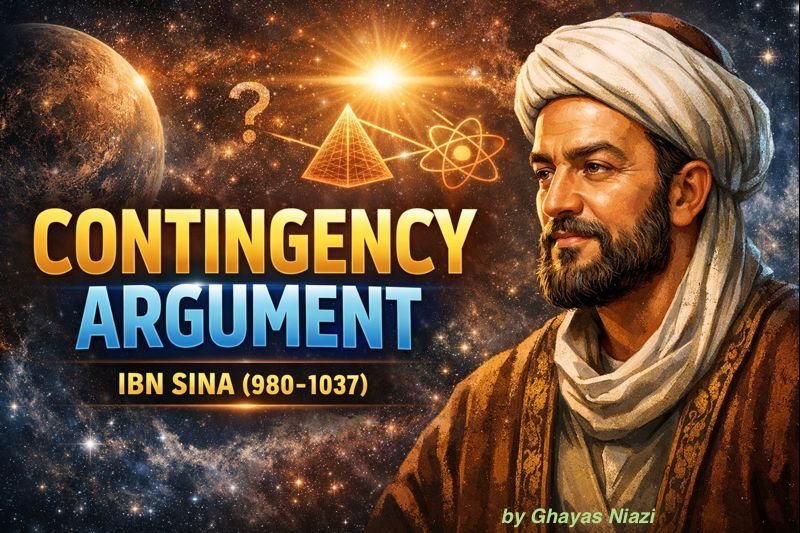
What is the Contingency Argument ? Ibn Sina, 980-1037
Contingency Argument ? Ibn Sina, 980-1037: Avicenna (Ibn Sina, 980-1037): Developed a sophisticated metaphysical distinction between contingent (mumkin) and necessary (wājib) existence. He argued that the chain of contingent causes must terminate in a being whose existence is necessary in itself (Wājib al-Wujūd). Many scholars consider Avicenna (Abū ʿAlī al-Ḥusayn ibn ʿAbd Allāh ibn Sīnā) the true originator of the fully-formed contingency argument. Thomas Aquinas was likely influenced by Islamic philosophy via Latin translations.
So, while the first systematic, major use is often attributed to Ibn Sina, its most famous articulation in Western philosophy is by Thomas Aquinas.
It is a traditional argument supporting the existence of God, classified within the category of cosmological arguments. Its fundamental framework is:
Table of Contents
Observation of Contingency:
We recognize that numerous, or potentially all, phenomena in the universe are inherently contingent. A contingent entity is one that does not embody within itself the justification for its own existence. It relies on an external factor for its existence and may potentially not have existed. (e.g., a tree, a star, a human—all arise and cease to exist as a result of external factors).
Impossibility of infinite regress of contingent causes:
If all entities are contingent, then the existence of a particular thing would require an infinite regress of prior contingent causes. Supporters argue that this is either metaphysically incorrect or impossible. They argue that the idea of a never-ending series of connected things does not explain why there is something rather than nothing. It simply postpones the problem forever.
The Necessity of a Necessary Being:
Therefore, to explain the existence of contingent beings, there must be a Necessary Being. This is a being whose existence is not dependent on anything else; it contains the reason for its existence within its own nature. It cannot not exist. It is self-existent, eternal, and uncaused.
Identification:
This Necessary Being is what we call God.
In simple terms: “Why is there something rather than nothing?” The contingency argument answers: Because a necessary, non-contingent foundation (God) exists to ground all contingent things.
Contingency Argument: Its First Major Use
The argument is most famously associated with Thomas Aquinas (1225-1274) in his Summa Theologica (c. 1274), specifically in his “Third Way” (the “Argument from Possibility and Necessity”).
How Aquinas Formulated It (Third Way):
1-We find in nature things that are possible to be and not to be (i.e., contingent things that are generated and corrupted).
2-It is impossible for these always to exist, because that which can not-be at some time is not.
3-If everything could possibly not exist, then at one time there would have been nothing.
4-If there had been nothing, then nothing would exist now, because nothing can come from nothing.
5-Therefore, not all beings are contingent. There must exist a Necessary Being.
6-Every necessary being must have its necessity caused by another or not.
7-One cannot proceed to infinity in necessary beings that have a cause of their necessity.
8-Therefore, we must posit a Necessary Being that exists through its own necessity and causes the necessity in others. This all men call God.
Key Philosophical Predecessors:
Although Aquinas provided its traditional formulation, the origins can be traced to:
Aristotle:(384–322 bc)
Distinguished between “potentiality” and “actuality,” and argued for a “Unmoved Mover” as a pure actuality, which is a necessary being.
Avicenna (Ibn Sina, 980-1037):
Formulated a nuanced metaphysical distinction between contingent (mumkin) and necessary (wājib) existence. He contended that the sequence of contingent causes must conclude with an entity whose existence is necessary in itself (Wājib al-Wujūd). Many scholars consider Avicenna the genuine originator of the fully-formed contingency argument. Aquinas was probably influenced by Islamic philosophy through Latin translations.
So, while the first systematic, major use is often attributed to Avicenna, its most famous articulation in Western philosophy is by Aquinas.
How Modern Science Views and Defines “Contingency”
Science does not use the term “contingency” in the same metaphysical sense. Instead, it uses related concepts in a descriptive, empirical way. The scientific worldview profoundly impacts how we interpret the premises of the contingency argument.

1. Contingency as Causal Dependence (Physics and Cosmology):
Science characterizes a universe governed by physical laws. The condition of the universe at time is contingent upon its state at time and the governing laws.
Cosmology: The Big Bang theory delineates the origin of the universe from an initial singularity approximately 13.8 billion years ago. The universe, along with all that it encompasses, is contingent in that its present condition is causally reliant upon preceding circumstances.
Primary Scientific Challenge to the Premise
(4): Aquinas’s assertion that “nothing comes from nothing” (ex nihilo nihil fit) is contested by quantum field theory. In quantum mechanics, virtual particles emerge and vanish spontaneously within a vacuum, phenomena known as quantum fluctuations. Although not a creation “ex nihilo” in an absolute philosophical sense (as they originate from quantum fields and energy within spacetime), this demonstrates that our classical intuitions regarding causation can fail. Certain cosmological models, such as the Hartle-Hawking model, propose that the universe may have originated from a quantum event, potentially without the necessity of a preceding external cause.
2.Contingency vs.Necessity in Evolutionary Biology:
Stephen Jay Gould made the word “contingency” very important, and it has a special meaning here.It has to do with the idea that the specific historical paths of things have a big effect on the results of development. If we could “re-run the tape of life,” it’s possible that random mutations, changes in the environment, and mass extinctions would make things very different. Life forms depend on an extensive and uncertain evolutionary history.This historical contingency underscores the philosophical concept that living entities are contingent beings—they are not metaphysically necessary and are the result of an extended, dependent sequence of events.
3.The Limits of Science Regarding a “Necessary Being”:
Science deals with the contingent, natural order. By its methodological naturalism, it does not and cannot make claims about supernatural necessary beings.
Science can ask: “Is the universe itself necessary or contingent?”
Contingent Universe View: Most standard Big Bang models imply a beginning, suggesting a contingent universe (it came into being). What, if anything, caused it is outside standard physics.
Self-Contained/ “Necessary Being” Universe Models: Some theoretical models (like certain interpretations of eternal inflation or the multiverse, or a universe described by a theory of everything) posit a universe (or multiverse) that is eternal and self-explanatory through physical law. In these models, the cosmos itself could be seen as a “necessary” entity in a physical sense—it has no external cause because it exists in some form necessarily due to fundamental principles. This is the closest science gets to the idea of a “necessary being,” but it’s a physical necessity of existence, not the metaphysical necessity of Aquinas. It is not a person; it is a state of affairs or a physical entity.
The Modern Dialogue
The argument now exists in a complex space between philosophy, science, and theology:
Supporters (like William Lane Craig) reformulate it using modern cosmology (e.g., the Kalam Cosmological Argument):
(1) Everything that begins to exist has a cause.
(2) The universe began to exist (citing Big Bang cosmology and arguments against actual infinities).
(3) As a result, the world has a cause, which we call God.
Critics say:
The Composition Fallacy: If every part of the universe is likely to happen, does that mean the whole universe is likely to happen? Maybe the collection is important.
In Question
4: Quantum physics questions the idea that “nothing comes from nothing.”
Unjustified Leap to God: If there is a required ground, why does it have to be a personal, all-powerful, loving God? There’s a chance it’s a cold, impersonal physical theory or fact.
Answer to the Brute Fact:
The universe (or multiverse) might just be a fact that can’t be explained any further. It might be a category error to want an answer for everything.
Summary
| Aspect | Philosophical/Theological Definition | Scientific Perspective |
| Contingent Being | A being whose existence depends on another and could possibly not exist. | An entity whose state is causally dependent on prior states and the laws of physics. Historical outcomes (like life) are path-dependent. |
| Necessary Being | A being whose existence is self-explanatory, uncaused, and cannot not exist. Often identified with God. | Not a scientific concept. The closest analogs are: 1) Fundamental physical laws/mathematical truths, or 2) A self-contained, eternal multiverse that exists necessarily due to physical principle. |
| The Argument | Explains contingent beings by deriving a metaphysical Necessary Being. | Science explains contingent states via prior states + laws. The ultimate “why” of existence (Why these laws? Why something?) is outside empirical science’s domain; it’s a metaphysical question. |
Conclusion: Contingency Argument ? Ibn Sina,
The Contingency Argument was first robustly formulated by Avicenna (Ibn Sina) and later popularized by Aquinas as a metaphysical deduction from the nature of existence. Modern science redefines “contingency” in empirical, causal terms and provides descriptions of cosmic and biological dependence that both challenge some of the argument’s classical assumptions (like ex nihilo nihil fit) and offer alternative, naturalistic models for a self-existent cosmos. The argument thus remains a powerful philosophical idea, but its force now hinges on one’s acceptance of its metaphysical premises in light of modern scientific understanding.
FAQ: The Contingency Argument, Avicenna, Aquinas, and Modern Science
Q1:What is the argument for the alternative?
A:The Contingency Argument is a well-known philosophical reason to believe that God exists. It goes from the existence of contingent beings (things that couldn’t exist) to the presence of a necessary being (God) whose existence is clear and can’t be explained.
Building Blocks:
Premise 1:There are contingent beings, which are things that rely on something else to exist.
Premise 2: There would be no end reason for anything existing if everything were contingent.
Premise 3: Third, an infinite regress of possible reasons does not help explain this issue. Because of this, there must be a Necessary Being (whose presence is inherent and cannot be caused) as the ultimate cause of all contingent things. People call this being “God.”
Q2: Who first developed the Contingency Argument?
A: Although the argument goes back to Aristotle, many experts believe that Avicenna (Ibn Sina, 980–1037) was the first person to fully develop it on a metaphysical level. He made the important difference between:
Things whose presence depends on outside factors are said to have contingent existence.
Needful Existence (wājib al-wujūd): A thing that exists because it is what it is and can’t not exist.
Necessary Existence (wājib al-wujūd): Avicenna said that the chain of possible outcomes must end in a Necessary Existent (Wājib al-Wujūd).
Q3:Just what does Thomas Aquinas have to do with the case?
A: Thomas Aquinas (1225–1274):Most people in the West know Thomas Aquinas’s “Third Way” (Summa Theologica), which he wrote between 1225 and 1274. Some works by Avicenna and other Islamic thinkers were translated into Latin and brought to Europe in the Middle Ages. These books had an impact on Aquinas. Aquinas gave the argument the form it takes in the West, but he started with Avicenna’s ideas.
Aquinas added it to Christian natural theology, while Avicenna built on it in Islamic theory.
Q4: Are Aquinas and Avicenna the same person?
A:Not at all. They are two different thinkers who lived in different times, cultures, and religions:
Avicenna: From 980 to 1037, Avicenna was a Persian Muslim who wrote in Arabic and Persian.
Aquinas: From 1225 to 1274, Aquinas was an Italian Christian who wrote in Latin.
Avicenna was a very important intellectual mentor to Aquinas because he studied and talked about Avicenna’s ideas through translations.
Q5:How does modern science view “contingency”?
A:Definitions in science are based on facts and causes, not on ideas or concepts.
A. Cosmology and physics:
The universe’s state depends on its past states and the laws of physics.
According to the Big Bang theory, the universe may not have had a beginning (about 13.8 billion years ago), which means that the universe may not be a cause-and-effect thing.
Quantum mechanics: If you think about how virtual particles form from fluctuations, for example, quantum physics questions the idea that “nothing comes from nothing.”
B. Biology of evolution:
“Contingency” in this case refers to depending on past events (Stephen Jay Gould). Chance events are what make life evolve, so biological outcomes rest on long, uncertain histories
C: Can the world be said to be “necessary”?
Some theories, like eternal inflation and the multiverse, suggest that the universe is self-contained and will always exist because of the way physical rules work. This is not the kind of metaphysical requirement that Avicenna or Aquinas talked about.
Q6: What are the biggest problems with the Contingency Defense?
A: Fallacy of Composition: Making the mistake of thinking that since every part of the universe is uncertain, then the whole universe must also be uncertain.
Questioning “Ex Nihilo Nihil Fit”: Putting “Ex Nihilo Nihil Fit” to the Test: In quantum physics, particles can come from quantum fields, which goes against the idea that “nothing comes from nothing.”
Unjustified Leap to God: Leap to God Without a Reason: If there is a Necessary Being, why does it have to be a personal, all-powerful, good God? It could be a cold idea or a simple fact.
The Brute Fact Response: The Brute Fact Response: The world may just exist without a reason from outside sources. This is a brute fact.
Q7: How do current supporters of the idea, such as William Lane Craig, reframe the argument?
A: Craig’s Kalam Cosmological Argument is like a cousin from today:
There is a cause for everything that starts to appear.
Based on the theory of the Big Bang and philosophical arguments against real infinities, the universe started to exist.
As a result, the world has a cause, which we call God.
This applies the idea of chance to the modern field of scientific cosmology.
Q8: Can science show that the Contingency Argument is true or false?
A: Methodological naturalism guides science, which looks at the natural, changing order of things. So:
A metaphysical Necessary Being is not something that science can directly handle.
It can add to the debate by talking about the history of evolution, the origins of the universe, and quantum phenomena, which may call into question or change the premises of the case.
In the end, the case is based on metaphysical reasoning, which is not part of empirical science.
Q9: What does the Contingency Argument mean for the long term?
A: It is still a strong philosophical tool for asking basic questions like “Why is there something instead of nothing?”
It brings together ancient, medieval, and modern ideas to show how ideas change over time and between countries (from Avicenna to Aquinas to now).
It shows how philosophy, religion, and science are always talking to each other (and sometimes fighting) as people try to figure out what life is all about.