
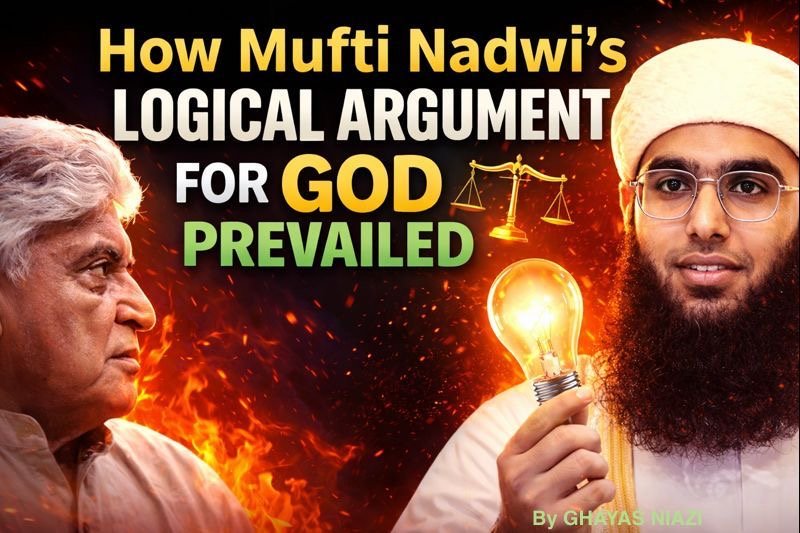
How Mufti Nadwi’s Logical Argument for God Prevailed
The Necessary Being: Mufti Nadwi’s Unanswered Logical Argument for God’s Existence
How Mufti Nadwi’s Logical Argument for God Prevailed: The recent public conversation between poet-lyricist Javed Akhtar and Islamic expert Mufti Shamail Nadwi was more than just a disagreement between two people. It was a rare clash of worldviews: reasoned faith against empirical doubt. The conversation covered a lot of ground, from morality to human suffering, but at its heart was Mufti Nadwi’s deep philosophical challenge, which the atheist stance still doesn’t really answer. This was not a victory of scripture over science but of foundational logic over what can be described as a worldview of intellectual resignation.
Table of Contents
1. Framing the Debate: Establishing the Correct Standard of Proof
How Mufti Nadwi’s Logical Argument for God Prevailed: Mufti Shamail Nadwi began by strategically and decisively setting the terms of engagement. He argued that to have a meaningful dialogue, both parties must agree on the correct “standard” or tool for investigation.
Rejection of Science as the Standard:
Rejection of Science as the Standard: He stated that science, by its nature, deals with empirical evidence from the physical, natural world. Since God is conceived as a non-physical, supernatural reality, science is the “wrong tool” to prove or disprove His existence. It would be like using a metal detector to find plastic.
Setting Aside Religious Revelation:
Setting Aside Religious Revelation: While revelation is a valid source of knowledge for believers, he acknowledged it holds no weight for a skeptic like Javed Akhtar. Therefore, he pledged not to use any scriptural evidence.
The Primacy of Reason and Logic:
The Primacy of Reason and Logic: Having eliminated other standards, Mufti Nadwi declared that the only valid and common ground for this debate is reason, logic, and philosophical argument. He promised to present a definitive logical case, akin to “two plus two equals four,” that the atheistic world could not refute.
2. The Core Argument: The Cosmological Argument for a “Necessary Being”
This was the central, positive case presented by Mufti Nadwi, often called the argument from contingency.
The Premise of Contingency: The idea behind contingent reality is that everything we see in the world, from a simple pink ball to the most complicated galaxy, is “contingent.” So, it doesn’t have to exist; it could have been different, or it might not have existed at all, depending on other things. The most contingent fact is the universe itself, which is limited by time and space.
The Role of the Dinosaur Example:
Akhtar uses dinosaurs as a specific, tangible example to challenge this. His point is:
If religious texts were a source of complete, fundamental knowledge about creation and history, one might expect some mention of these massive, dominant creatures that existed for over 150 million years.
The fact that there is “no mention of dinosaurs in any religious book of the world” is, for him, evidence that these texts are products of their specific human time and context, not repositories of all-encompassing, eternal truth.
It serves to support his larger plea for intellectual humility—the idea that we should say “we don’t know” about many things rather than claiming definitive, faith-based knowledge.
The Trouble with Infinite Regress: If everything has a cause, then there is an endless line of causes that go back in time. Mufti Nadwi said that this is logically impossible in the real world because you can’t have an endless chain of things that depend on each other with no starting point that is independent.
The Logical Conclusion – The Necessary Being:
The logical conclusion, or the need to be: Logic tells us to stop at a “Necessary Being” (God) so we don’t fall into this trap. This thing’s existence is not dependent on anything else; it lasts forever, has no cause, and can take care of itself. All contingent things rely on this Necessary Being to exist in the end. This Being must also be strong (to make things) and smart (because the world is set up in a certain way).
3. Countering Javed Akhtar’s Central Objections
On the “God of the Gaps” and Scientific Progress
Akhtar said that throughout history, God has been used to fill in gaps in what people know, like lightning or rain, which was later explained by science. In a way, this makes God a thought that is always moving away.
Responding, Mufti Nadwi changed the whole meaning of this. Scientific answers only talk about how things work and what their properties are, like matter, energy, and forces. It’s still necessary to have a car creator even if you can explain how an engine works. In fact, realizing how complicated the engine is makes it clearer that it needs a creator. In the same way, every new scientific finding shows us more about how amazingly complicated the universe is. This makes the case for an intelligent Creator of that system stronger, not weaker.
On the Problem of Evil and Suffering
Akhtar’s most powerful point made people feel bad because she asked how an all-powerful, all-loving God could let terrible things happen, like children dying in wars.
Response from Mufti Nadwi: There is evil in the world, he said, but that is not proof that God does not exist; it is important for God’s plan.
The Point of a Test: This world is a place of failure and moral responsibility. There would be no real test of character, no real choice between good and evil, and no real justice in the future if evil didn’t exist.
Human Free Will: A lot of pain happens when people abuse their God-given free will, like when they start a war. God lets this freedom happen, even though it leads to evil, because there is no moral value in a world where everything is pre-programmed and people have no choice. The person who did this, not God, is responsible and will be held responsible.
Human Perception Limitations: Since God is all-knowing and all-wise, he may have reasons for letting people suffer that we can’t understand. We put up with a doctor’s painful treatment because they know better than us. Similarly, we can’t judge God’s plan from our narrow point of view because He knows everything.
On the Definition of “Faith”
On the Definition of “Faith”
Akhtar defined faith as “belief without proof, witness, rationale, or logic”—essentially, blind belief or even “stupidity.”
Mufti Nadwi’s Rebuttal: He corrected this as a fundamental epistemological error. Faith can be right or wrong. The faith he advocates is “true faith”—a belief that is supported by logic, reason, and evidence (the cosmological argument). He distanced himself from “false faith” that has no rational basis, putting himself and Akhtar on the same page against blind belief.
4. Exposing Weaknesses in the Atheistic Position
Throughout the debate, Mufti Nadwi turned the spotlight on the internal consistency of Akhtar’s atheistic worldview.
The Incoherence of “We Don’t Know”: He noted that while Akhtar often retreated to “we don’t know” about the universe’s origins, he simultaneously made the definitive positive claim that “God does not exist.” This, Mufti Nadwi argued, is philosophically inconsistent—you cannot claim knowledge of non-existence while professing ignorance of the cause.
The Problem of Objective Morality: When challenged to define evil without God, Akhtar suggested morality is decided by social consensus or is necessary for communal living. Mufti Nadwi pounced on this, arguing that this leads to subjective morality. If the majority of society (like Nazi Germany) consensus approves of an atrocity, it becomes “right” under this system. Only an objective moral lawgiver (God) can provide a foundation for objective good and evil that stands above human opinion.
Conclusion: How Mufti Nadwi’s Logical Argument for God Prevailed
Mufti Nadwi’s direct, unanswered question about the cosmological argument was the most important part of the conversation. He kept telling Akhtar that he had to make a decision: either accept that there must be a Necessary Being based on logic, or support the idea that there could be an infinite chain of causes. That Akhtar asked why we had to ask the question or said “we don’t know” were not arguments against the theory.
Mufti Nadwi proved that the presence of a Necessary Being is not just a religious belief, but also a logical must.
The usual arguments against religion focus on what God or His people do, not why He should exist.
If there is no First Cause, there is no good reason for anything existing. The only options are an unsatisfactory “infinite regress” or a claim of ignorance.
This well-organized analysis shows that Mufti Shamail Nadwi’s point of view is a strong logical one. It supports belief in God with basic reason, protecting it against common empirical and emotional attacks, and it challenges atheism to offer a similarly strong explanation for reality itself
FAQ: How Mufti Nadwi’s Logical Argument for God Prevailed
Q1-What You Need to Know About Mufti Nadwi’s Case in the God Debate
A-What was the main point of the argument between Mufti Shamail Nadwi and Javed Akhtar?
The main point was to look at the most important question: “Does God exist?” The argument turned into a fight between two ways of knowing: Javed Akhtar’s empirical skepticism (which is based on what can be seen and proven) and Mufti Nadwi’s philosophical theism (which is based on using logic to figure out what reality is). It wasn’t really about comparing religions; it was about whether basic logical reasons for a Creator were true.
Q2-Why did Mufti Nadwi start by rejecting science and scripture as “standards of proof”?
A-He did this to make sure that everyone could agree on what was being said. He said this:
Just like a metal detector can’t find plastic, science is the “wrong tool” for looking into things that aren’t solid.
For believers, religious texts are true, but for skeptics, they don’t hold much weight.
He tried to make a case that could stand on its own among people of any religion or scientific field by bringing the discussion to the neutral ground of pure logic and philosophical reasoning.
Q3-What did Mufti Nadwi mean by “Cosmological Argument” or “Argument from Contingency”?
A-This was the main point of his case. It can be broken down into a simple chain of logic:
All the things we see in the universe are “contingent.” This means that it’s not required to exist; other things make it so. Maybe it’s not there at all or it’s different.
If everything has to have a cause, then there is an endless chain of causes (A is caused by B, which is caused by C, and so on). This chain can’t just hang there without a place to start, that makes no sense.
As a result, there must be a single ultimate “Necessary Being” that started the process. This Being must last forever (not limited by time), be self-sufficient, have the power to create, and be smart (as shown by the order of the world).
Q4-When Javed Akhtar asked, “If God exists, then why is there so much evil and suffering?” Mufti Nadwi gave this answer.
A-He claimed that the existence of evil does not mean that God does not exist; rather, it is necessary for God’s plan:
Why There Is a Test: This world is a place of trials. There can’t be real moral decision, courage, or compassion without the possibility of evil. This means that there can’t be real justice or accountability in the afterlife.
Human Free Will: People who abuse their God-given free will (like a killer or a tyrant) cause a lot of pain. Not letting this happen would mean taking away moral freedom itself.
Limited Human Knowledge: An all-knowing God may have reasons for letting some people suffer that we can’t understand, just like a patient trusts their doctor’s painful treatment plan.
Q5-How did Mufti Nadwi respond to the criticism of “God of the Gaps”?
A-Some people say that God is used to fill in holes in scientific knowledge, but those gaps are getting smaller as science moves forward. This was turned around by Mufti Nadwi. He said that science only explains the how (the laws and mechanisms) and not the why (why is there something instead of nothing and why the rules exist at all).
Every new scientific finding, like the Big Bang or the universe’s fine-tuning, shows a deeper, more complex level of reality that is always changing. It’s clearer that you need an expert after reading about a car’s engine, not because of it. In the same way, growth in science makes it more logical that the whole system must have an intelligent First Cause.
Q6-What was the main flaw in the atheist view that Mufti Nadwi pointed out?
A-He brought up a major contradiction and a logical issue:
The Irrelevance of “We Don’t Know”: He pointed out that Akhtar would often say “we don’t know” when asked about the beginning of the world, but at the same time he said for sure that “God does not exist.” This isn’t a good intellectual argument because you can’t say for sure that you know something doesn’t exist while also saying you don’t know what causes it.
Why objective morality doesn’t work: Akhtar said that evil is based on society consensus when asked to describe it without God. Mufti Nadwi said this leads to subjective morality, which means that what is right and bad is just what most people think, like in Nazi Germany. Objective good and evil can only be based on a higher moral lawgiver, like God.
Q7- In the end, did Mufti Nadwi “win” the argument?
A-The article says that Mufti Nadwi successfully supported a position that makes sense and can’t be argued against. It was a good case (the Cosmological case) that Javed Akhtar didn’t show how to break down logically. Instead, Akhtar’s main points were his emotional and practical criticisms of organized religion and the problem of suffering. These are both important issues, but they are not logical proofs that God does not exist, according to Mufti Nadwi. So, from a philosophical point of view, the main logical question about a “Necessary Being” was still unsolved.