
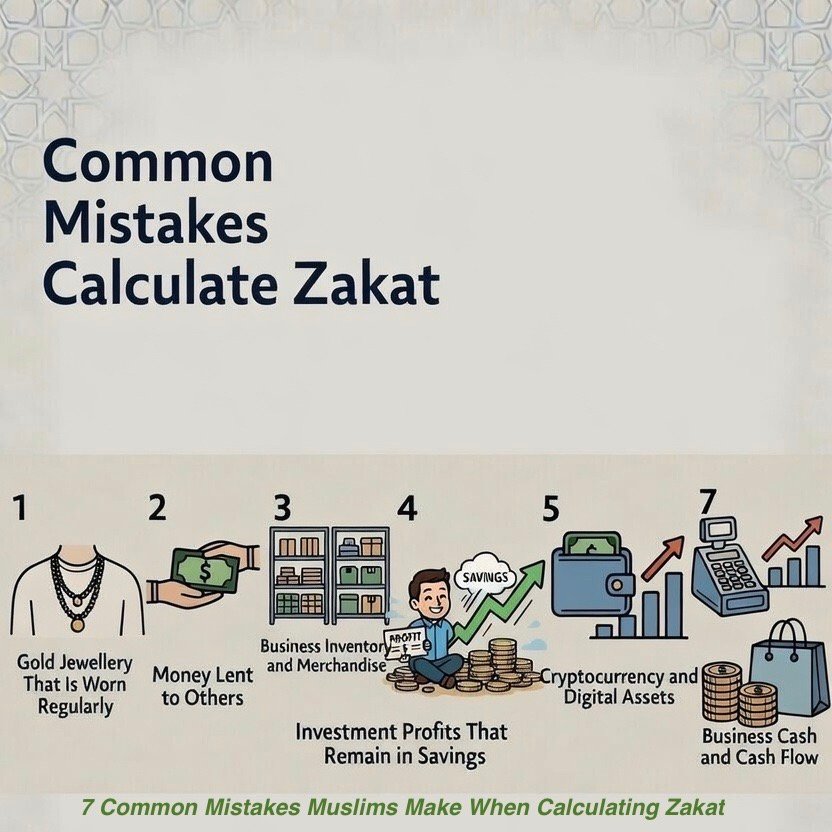
7 Surprising Things That Need Zakat (Many Muslims Forget About Them)
7 Common Mistakes Muslims Make When Calculating Zakat (Many Muslims Forget About Them)
7 Surprising Things That Need Zakat (Many Muslims Forget About Them): Are you making these 7 common Zakat mistakes? Learn which surprising assets (like loans you gave out and business inventory) are due for Zakat and how to calculate them properly.
One of the five bases of Islam is zakat, which is an important act of worship that helps those in need and cleans up wealth. Many Muslims know that they need to pay Zakat on their savings, gold, and some businesses. But there are other types of assets that are often forgotten. Because of this, every year some people pay too little Zakat without meaning to.
To make sure that your Zakat is calculated properly, you should know what kinds of wealth are zakatable. A lot of Islamic scholars agree that Zakat refers to money that could grow or make more money. This includes money, goods for trade, and other things that can be used as money.
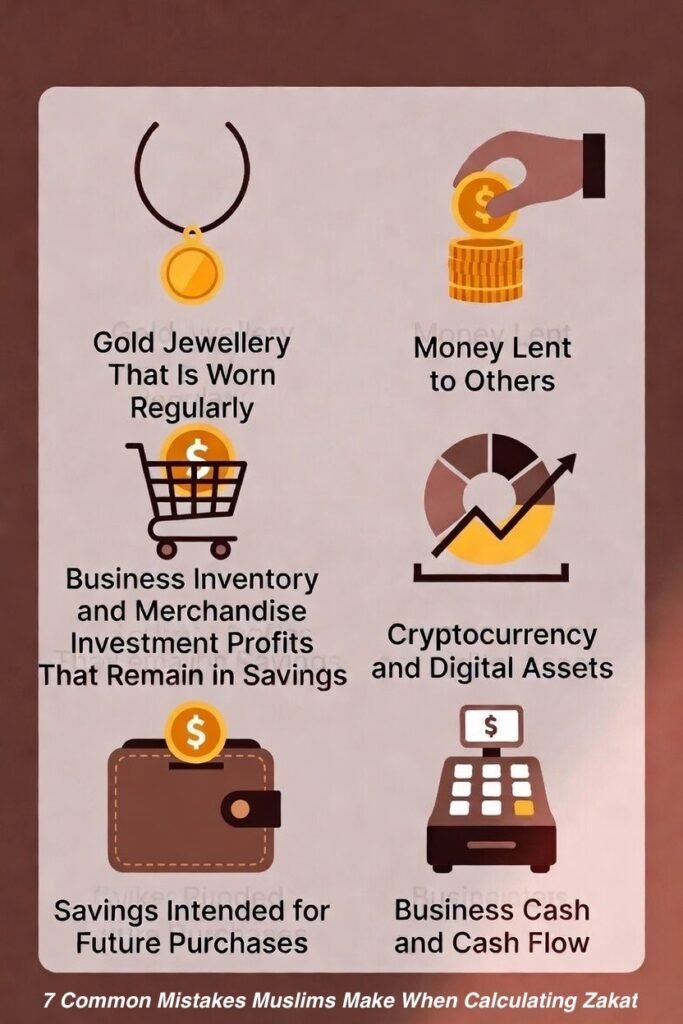
Here are seven surprising things that often need Zakat but are forgotten when people figure out their monthly duty.
Gold Jewellery That Is Worn Regularly
A lot of people think that jewelry worn for personal reasons is not subject to Yakat. Numerous teachers, on the other hand, say that gold and silver jewelry are still subject to Zakat, even if they are not worn often.
As an example, someone might own gold bands, necklaces, rings, or bangles that they bought to look nice. These things are still wealth even though they are not being bought or sold. Gold and silver are usually counted toward Zakat because they have value on their own and are easy to turn into cash.
The important thing to remember is that Zakat is based on how much the gold or silver is worth on the market right now, not how much was paid for it when it was first bought. If someone’s zakatable wealth, which includes jewelry, hits the Nisab level and has stayed there for one lunar year, they have to pay zakat.
2. Money Lent to Others
People also often forget about money they’ve given to family, friends, or business partners. When you lend someone money and expect to get it back, that money is usually counted as part of your wealth.
If someone gives a friend £5,000 with the agreement that the money will be returned, that amount should still be taken into account when figuring out Zakat. The lender still has legal ownership of the money, even though it is currently in the care of someone else.
Some scholars say that if you are likely to return the loan, you should pay Zakat every year. Some people say that Zakat should be paid when the money is returned. The loan can’t be left out of the equation in either case.
A lot of people don’t realize how much zakatable wealth they have because they only look at the money in their bank accounts.
3. Business Inventory and Merchandise
Businesses are required to determine Zakat in accordance with the inventory they possess for sale. This encompasses items that are sold in stores, items that are stored in warehouses, and items that are sold in quantities.
The zakatable wealth of a shop proprietor is the sum of the market values of all the items they sell, including electronics, books, clothes, and other items. In the same vein, an individual who operates an online store must specify the value of their inventory.
Most of the time, the expected selling price of the goods at the time Zakat is due is used instead of the price that was paid for them in the first place. When you add up the values of all of your zakatable assets and bills, and then take away the values of your inventory, you get the standard rate of 2.5%.
Business goods can be worth a lot of money, so forgetting to include it can cause a big mistake in the calculations.
4. Investment Profits That Remain in Savings
Stocks, mutual funds, and other types of investments can earn you money in the form of income or gains. If people take these earnings and save them, they become part of their zakatable wealth.
For example, if someone owns stocks and saves the dividends money in a bank account, that money is treated like any other savings. If the total wealth is more than Nisab and a lunar year has passed, Zakat must be paid on that amount.
The cash profits that build up over time, even if the investments are for a long time, are still due to Zakat. A lot of people forget this because they only think about their main bank account and not the money that comes in from investments.
5. Cryptocurrency and Digital Assets
In the past few years, cryptocurrency has grown into another form of wealth that many people around the world own. A lot of people think of digital currencies like Bitcoin and Ethereum as assets that have value and can be sold or turned into cash.
Because of this, most modern experts see cryptocurrency as wealth that can be used for zakat. If someone has digital assets worth more than the Nisab limit, they need to pay Zakat.
The market price at the time Zakat is paid is often used to figure out the amount. Since the prices of cryptocurrencies can change a lot, the valuation should be based on the value on the day that the Zakat figure is made.
As digital money spreads, more and more Muslims are realizing that cryptocurrencies should not be forgotten when figuring out Zakat.
6. Savings Intended for Future Purchases
A common mistake is that money set aside for a certain reason is not subject to Zakat. Saving money does not get rid of the duty to perform Zakat, despite what some people think.
One might be saving for things like:
Amr or Umrah
A down payment on a house
A new car
Costs of education
Getting married costs
The person has saved the money for a big goal in the future, but it is still part of their wealth while it is in their account. So, if the amount is more than the Nisab and a lunar year has passed, Zakat must be paid.
A lot of people put off paying Zakat on these kinds of savings because they think the money is already “set aside.” From the point of view of Zakat, it is still possible wealth.
7. Business Cash and Cash Flow
The cash that a business has is another asset that is easy to forget about. This can be money in a business’s bank account, cash on hand, or operating capital that is used for day-to-day tasks.
The owner or partners still own this money, even though it’s used to run the business. Because of this, it is part of their zakatable wealth.
A small shop might keep a few thousand pounds in a till or business account so that it can buy goods and keep track of its spending. When calculating other assets that can be used for zakat, this money should be included.
Before determining the final Zakat amount, business owners subtract any short-term debts or liabilities and accumulate their cash, inventory, and other assets that qualify.
Why Understanding Zakatable Assets Matters
Properly calculating Zakat is not only a religious obligation, but also a financial one. Zakat ensures that resources are distributed throughout the community and that prosperity is cleaned up, thereby assisting individuals who are impoverished or in debt.
Without intending to, Muslims may fail to pay the appropriate amount of Zakat when they neglect certain obligations. Conversely, comprehending the true definition of zakatable wealth enables individuals to fulfill their obligations with sincerity and assurance.
One good way to keep track of your wealth is to look at it all once a year and ask yourself one simple question: Is this asset money or something that is easy to turn into money? It might need to be added to the Zakat estimate if the answer is yes.
Conclusion:7 Common Mistakes Muslims Make When Calculating Zakat
Zakat is to make people more fair, caring, and accountable to others. Many people remember to calculate Zakat on their bank savings, but it’s easy to overlook other things.
Zakat may be due on things like gold jewelry, business goods, investment returns, cryptocurrency, deposits for future purchases, and cash from a business. If you remember these things, you’ll be able to figure out your Zakat correctly every year.
FAQ: 7 Common Mistakes Muslims Make When Calculating Zakat
1. Do I have to pay Zakat on the gold jewelry I wear every day?
A-Yes, according to the majority of scholars. Even if gold jewelry is worn daily for personal use, it is still considered a store of wealth. You must include its current market value in your zakatable assets if it takes your total wealth over the Nisab threshold for a full lunar year.
2. I lent money to a friend. Do I still need to pay Zakat on it while they haven’t paid me back?
A-Generally, yes. Money that you have lent out with the expectation of getting it back is still considered part of your wealth. Most scholars advise that you should pay Zakat on it annually if you are confident the loan will be repaid. If the debt is with someone who is struggling and unlikely to pay, it may be treated differently.
3. Is Zakat due on money I am saving for a specific goal, like buying a house or a car?
A-Yes. In Zakat calculation, the purpose of the savings does not matter. If the money is sitting in your account, you have full access to it, and it has been there for a year, it is considered part of your wealth. You must pay Zakat on it regardless of what you plan to use it for in the future.
4. How do I calculate Zakat on my cryptocurrency?
A-Cryptocurrencies like Bitcoin are generally considered zakatable assets by modern scholars. You should calculate Zakat based on the market value of your crypto assets on the day your Zakat is due. If the total value meets or exceeds the Nisab, you pay 2.5%.
5. I own a small business. Do I pay Zakat on the products I haven’t sold yet (my inventory)?
A-Yes. This is a common mistake. You must calculate Zakat on your business inventory (stock-in-trade) . This means you take the current market value of all the goods you have for sale (what you could sell them for today) and add that to your cash assets before calculating your total zakatable wealth.
General Disclaimer:
“Always consult a Islamic scholar, or legal professional before making significant decisions.”
Liability:The author and publisher are not liable for financial, legal, or religious outcomes arising from the use of this information.